Posts|Comments

Category Archives: Devotional and Bible

Great Commission: What does GO mean?

Go therefore and make disciples of all the nations
- Jesus

I’ve heard it, haven’t you?  Speculation over that little word, go.  What does that mean?

You might have heard - I know I have - that in the original Greek this word is actually a participle, and could be more correctly translated "as you are going…"

But Dr. Daniel B. Wallace, Executive Director of the Center for the Study of New Testament Manuscripts says it ain’t so.

In some ways, the difference isn’t apparent - after all, if we’re going to reach the nations, somehow or other we have to get where the nations are.  Looking at other passages would clarify the situation too.

But then again, some people may point out that we don’t need to "go" - the point is that wherever we happen to be going, we should make disciples.

Anyway, Dr. Wallace, writing at the Parchment and Pen blog, says that this is a misunderstanding of the Greek.  Sure, the word is a participle.  But not a present participle, an aorist participle.  An being in proximity to an aorist imperative, it communicates a command.

No, grammar isn’t my strong pont either.  So I looked up some of the similar examples he cited in his article.  He says that Matthew 2:13-14 is an example of this, when the angel tells Joseph to flee to Egypt.  Can you imagine if the angel had said,"Well, if you happen to be getting up, be sure to take the child along and head over to Egypt…"

No way!  It was get up! Move it! Take the child and run for your life!

So the Greek construction here in Matthew 28 means - Go!  Skedaddle!  Move it on out!  It’s not the only command, of course.  Go and make disciples.

The disciples took this to heart.  In my 2000 Years of Missions seminar I show a map of the direction each disciple took (according to tradition) on their missionary trips.  They literally scattered in all directions, and I’m sure it wasn’t by accident.

Recently I heard a children’s show saying that if everyone told a neighbour (about the Gospel), and that neighbour told another neighbour, and another - soon everyone would know.  Well, it’s a great idea, and we certainly should share with our neighbours.  But in the real world, it wouldn’t work that way - everyone would not know.  Here’s why:

  1. Everyone doesn’t have that kind of connection - they’re in a fairly closed community where no one knows anyone who knows anyone who knows anyone who knows the Lord.  Someone must come in from the outside intentionally if they’re going to hear.
  2. There are people dying without having heard - if the chain doesn’t reach them in time, they will never hear
  3. Not every neighbour will believe, and so will not share the Gospel.

It’s not enough just to tell a neighbour.  There has to be some intentional going.  Remember Paul’s words in Romans 10.

Ok, so go means go.  How does that apply to us personally?  Well, that’s a whole other topic.  And Dr. Wallace will be continuing his analysis of the passage next week, which should be interesting.  Meanwhile, if you want the details you can read his original post on the Great Commission.

What do you think?  Have you heard discussion about the word go?  What do you think about the preaching you’ve heard on this passage?

via: JOLLYBLOGGER

Popularity: 3% [?]

If Christmas was all we knew

What if we earthlings knew little else besides the "Christmas story"?  How much would we know?  That’s what I set out to discover, more or less, as I read through the early chapters of Matthew and Luke this year.  Admittedly, I bring some previous knowledge to the story, but let’s try to get to the basics as much as we can…

The angel appears to Zacharias
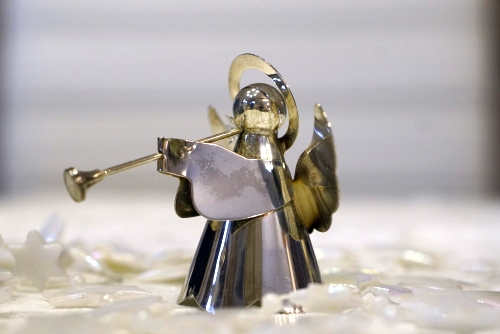
An artist’s depiction of the angel’s appearance to priest Zacharias

One of the earliest things that humans were to discover came from the story of the new baby - not Jesus, but his cousin John.  It became clear that a special time in history had come - a time when the people of Israel needed to return to God (Luk 1:16-17, 76).  (Was there a time when they shouldn’t return to God?  No, but at this time God sent them a guide - John.)

Then we find out about another special baby that was to come - a descendant of the great King David (Luk 1:32, 69).  As such, he would be the King of the Jews (Mat 2:2), the Lord (Luk 2:11), the Shepherd of Israel (Mat 2:6).  This great King would save Israel from their enemies (Luk 1:71).

But as you read on you find that there’s something more to this than the birth of a great King.  The new baby was the fulfillment of prophecies, and he was the fulfillment of God’s covenant with the nation of Israel (Luk 1:55, 71-72).  That would lead us to a whole lot more information about the baby, but for now let’s play more or less ignorant about the message of the Old Testament, and God’s covenant with Israel.  Suffice to say this was part of a greater plan.

Things are starting to sound more miraculous, especially when you find out how long the King’s reign would last - forever (Luk 1:31-33)!

How can that be?  Well, looking even closer at the story we find out why the baby was unique!  In some unique way, he was the Son of God (Luk 1:31-33, Mat 2:15).  These passages don’t seem to be suggesting that he was a son of God like everyone else - he was different.

In fact, woven into the Christmas story is the idea that God would be with the people of the world in a new way (Luk 1:68, Mat 1:23).  What exactly did that mean?

Another indication that the baby was unique was the manner of his conception.  He was conceived by the Holy Spirit, and born of a virgin (Luk 1:35, Mat 1:18,20)!  This seems to be a kind of explanation of why he would be called the Son of God.  This was not only a completely unique baby, coming from God, he also arrived as a part of God’s plan.  This wasn’t the idea of some couple doing family planning - it was all God.

No wonder generations later people would still consider Mary to be so special (Luk 1:48)!

This baby was clearly coming for the sake of the people of Israel.  He would be Israel’s help (Luk 1:54) and Redeemer (Luk 1:68, 2:38).  He would provide salvation, not only from enemies but from sins (Luk 1:69, Mat 1:21).  He would give them the freedom to serve God (reminding us of Moses’ request of Pharoah, to free Israel to worship God in the desert.  But excuse the digression to the OT!) (Luk 1:74).  He was Israel’s Consolation (Luk 2:25), and Glory (Luk 2:30-32).

No doubt, this person was going to shake up the status quo - he would be a sign that would cause the rising and falling of many in Israel (Luk 2:34-35).

If things aren’t interesting enough, let’s get personal for all us non-Jews.  This baby would be a revelation to the Gentiles (non-Jews) (Luk 2:30-32).  With the words of Simeon and the angels (Luk 2:14), the message widens to include all nations.  No one can ignore this birth - it will change everything.

The magi and the star
An artist’s conception of the magi following the star.

This person, Jesus, would be a bringer of joy (Luk 1:43-44) and peace (Luk 1:79, 2:14).  (John came ahead to lead people in the path of peace, and point them to this salvation (Luk 1:76-79))

And, as a mysterious shadow of what is to come, and a contrast of the other messages, we hear that this life will also somehow involve sorrow (Luk 2:35).  The salvation of the world, the changing of the nature of man’s relationship with God, this big shake up would somehow involve pain.

Near the end of what we usually consider the Christmas story we meet the three Magi.  Non Jews, but important people, they show the world-wide importance of the new child.  But they also do something that adds to the power of the words Son of God - they worship him.  In the context of what has come before, it seems clear that he is not just worshipped as a king, but as God Himself (Joh 1:1).

If you were to really believe the Christmas story, how would you respond?  The unique Son of God, come in the flesh to save the world from sin and bring joy and peace - to shake up the status quo and change the nature of the cosmos and our place in it.  If that’s all I heard, I would want to hear more.  What will He do?  How will this plan of God’s work out?  Of course, if you keep reading the New Testament, you’ll know the answer.

But just hearing the Christmas story, I’ve already found Someone to rely on to save the world.

Popularity: 5% [?]

Deeper Rejoicing

Habakkuk is a fascinating book, and Habakkuk 3 is a fascinating chapter.  This fall a few of us in Cuernavaca dug into it, just a little, and there is so much treasure there.  Habakkuk struggled with the big issues, and he asked the big questions, and he didn’t always find the answers.  When it came to rejoicing, he fought to understand what it is and how to do it, and it wasn’t just "grin and bear it" or "don’t worry, be happy".

The leadership (field council) of our organization in Mexico met in Cuernavaca this fall, and Brent Downs shared at our time together on the Sunday.  He and his wife had made this little bookmark, and I thought it was amazing, so I asked if I could share it with you.  Maybe it can kick off your study of this intriguing chapter.

If you want a better copy (to see or print), just click the image to go to a larger version in our Photo Gallery.

Habakkuk bookmark

Popularity: 5% [?]

Christians are religious. No they’re not. Or…

Are Christians religious?

Stained glass window

I have a feeling that question brings out some passionate responses in a lot of people.  For some, it’s an emotionally loaded issue.

It could be argued that it’s really a question of semantics.  Both the words "Christian" and "religious" are widely open to interpretation.  Christian probably started out as a derogatory term (in what is now Antakya, Turkey), and is now often used in a pretty general way based on heritage.  Religious - well, we’re getting to that.

But if you’re a follower of Jesus, are you religious?  If your answer is yes, should you admit it?

I’m going to offend just about everyone by saying that, no, Christians are not religious.  AND… yes, they are.

It’s been fairly fashionable for most of my lifetime to say that Christians are not religious.  I know, people are pulling this out now like it’s a new idea, but really it’s not.

Some of the arguments went like this:

  • Christianity is not a set of outward rituals, but a heart-change
  • Christianity is not things you must do, but a relationship with God
  • Christianity is not about organs, pews and dressing up on Sunday, it’s an inward change
  • Christianity is not "just another religion" but something different
  • Religion is man’s effort to reach God, Christianity is God reaching out to man (who came up with this one?  Just curious.)

There’s a lot of truth here (if a tad simplistic!).  I appreciate the effort to distance Christianity from …. well, trying to find salvation in a bunch of rules and rituals.  It is all about inward change, and a relationship.  This theme is repeated over and over in the Bible - following laws won’t save or transform you, it takes a work of God on the inside (see Gal 3:23-25 and Rom 3:10-27).

What does the Bible say about religion?  Religion isn’t a word commonly used of Christianity.  In Col 2:16-3:17 Paul contrasts human religion with the reality in Christ.  Human religion is a bunch of self imposed rules and false humility.  Christianity is a new life in Christ, in which we obey His commands.

James talks about religion as well, in a rather ironic way.  While assuming Christianity is a "religion", he actually talks about it as a kind of anti-religion.  Not so much concerned with ritual, pure religion to James is controlling your tongue, visiting orphans and widows, and keeping unstained from the world (Jam 1:26-27).  The Bible, it would seem, is rather suspicious of the term religion.

Religious?

On the other hand, look at it from the perspective of Joe I-don’t-believe-anything, or Sam I-ain’t-a-Christian.  Should you, a "Christian", say you’re not religious?

On the pro side, you’re distancing yourself from organs and pews, not eating ice cream on Sunday and whatever other rules you can think of.  You’re distancing yourself from "organized religion", which many people have had a bad experience with.  You’re focusing on something more relational, vital, real.

But then, lo and behold - you’re a member of a group with a common set of beliefs (Rom 6:17).  You get together with this group and perform rituals - like baptisms (Mat 28:19) and communion (1Cor 11:23-26).  You have a life focused around God and what you believe He wants you to do (Rom 12:1-2).

Boy, that sure sounds like a religion to me!  And … er … doesn’t following a religion make you religious?

If I were Joe I-don’t-believe-anything or Sam I-ain’t-a-Christian, I think I’d feel a little condescended upon, or, worse, manipulated, if I were told someone like this wasn’t religious.

  • Wikipedia: A religion is a set of common beliefs and practices generally held by a group of people, often codified as prayer, ritual, and religious law.
  • Mirrian-Webster: religious - relating to or manifesting faithful devotion to an acknowledged ultimate reality or deity
  • Oxford: religious - of, concerned with, or believing in a religion.
  • Oxford: religion - a particular system of faith and worship. or the belief in and worship of a superhuman controlling power, especially a personal God or gods.

Sounds like Christians are religious to me.

By almost any normal definition of the word, Christians are religious, and Christianity is a religion.  But we have to admit Christianity is different.  It is focused on God reaching us, not us reaching for God.  We aren’t Christians because we follow rules and rituals - it’s all about God’s grace toward us.  Pews and organs and abstaining from this or that - these aren’t defining factors of our faith, and people need to realize that.

So in the end, how would you answer?  Would it depend on who was asking?  In what context?  If you’re not a Christian, do you consider yourself religious?  Why or why not?

Are you religious?

Popularity: 8% [?]

  • Posts Jim is reading...

  • From Hannah & Nathanael's Wish List

Bad Behavior has blocked 1778 access attempts in the last 7 days.