We’re continuing our whirlwind review from last time. The next topic we studied was “the Image” – otherwise known in Latin as the Imago Dei.
We were created in God’s image – the animals were not. We’re very special. And as we learned, this is a reality that persists even after the Fall. Even in sin, we still maintain an incredible value because of the imago dei. Every human being.
We also learned that human want to change this image – they “exchanged the glory of the immortal God for images resembling mortal man and birds and animals and creeping things” (Romans 1:23). Instead of becoming more like the true God, whose image we bear, we became more like blind and powerless idols.
But Jesus Christ came to show us the true image of God – the exact image – as God in the flesh.
Long ago, at many times and in many ways, God spoke to our fathers by the prophets, but in these last days he has spoken to us by his Son, whom he appointed the heir of all things, through whom also he created the world. He is the radiance of the glory of God and the exact imprint of his nature, and he upholds the universe by the word of his power. After making purification for sins, he sat down at the right hand of the Majesty on high, having become as much superior to angels as the name he has inherited is more excellent than theirs.
Hebrews 1:1-4
That’s the story of Christmas! Everything in time and space truly matters, and has a purpose, because God Himself entered into His creation. And now we see the true and pure Image of God, sinless. And those who put their faith in Christ are being transformed into His image. “For those whom he foreknew he also predestined to be conformed to the image of his Son…” (Romans 8:29). “And we all, with unveiled face, beholding the glory of the Lord, are being transformed into the same image from one degree of glory to another. For this comes from the Lord who is the Spirit” (2 Corinthians 3:18).
From there we went on to talk about God’s design for the family. According to the Lord Jesus, God’s pattern for the man and the woman and marriage and children in Genesis is the pattern that we are to follow today.
When the man rebelled against God, human beings began to experience shame and confusion about their own bodies. This is part of the fallen world. But God has given us commandments for the family and its gender roles. Those roles are different for men and for women.
We all experience sin and brokenness in this area. But God gives forgiveness and healing to those who turn to Him.
All of this information about the man and the woman and the image of God also related to our next study, “The Borders of Life”. We went through the various types of murder that the Bible talks about, relating them somewhat to modern law. We talked about the attacks that we’re seeing on life today, especially on the “borders” – the murder of babies in the womb (often called “abortion”), and the murder of our precious seniors through negligence and euthanasia.
One of the most important parts of that lesson for me, apart from some questions about specific kinds of murder, was the Bible’s teaching on suffering and death.
In Scripture, death is the enemy. A consequence of sin. Yes, for a Christian, death is a path to being with the Lord. But this comes at a time chosen by God, not by us. We are here on earth to serve as long as God permits, even if we can only serve through brief moments of prayer on our sickbed.
Suffering, for us, is full of purpose. It is not something to be avoided at all costs. In fact, we are even commanded to suffer for Christ. “Share in suffering as a good soldier of Christ Jesus” (2 Timothy 2:3). Listen to Romans 5 –
Not only that, but we rejoice in our sufferings, knowing that suffering produces endurance, and endurance produces character, and character produces hope, and hope does not put us to shame, because God’s love has been poured into our hearts through the Holy Spirit who has been given to us.
Romans 5:3-5
Every life has purpose and value, even a life that is deep in suffering. “For this light momentary affliction is preparing for us an eternal weight of glory beyond all comparison…” (2 Corinthians 4:17).
Of course it’s impossible to delve back into all these topics again – but that’s a summary of “The Image”, “The Family”, and “The Borders of Life”. Remember to check here for a more detailed discussion. We’ll continue starting with part 6 next time!
To close out our series on Biblical Anthropology, I’m going to try to pull everything together in just a few posts. But if you’re actually following the series, I encourage you to read it all, because there will be a lot more holes in this summary if you don’t!
If you have started at the beginning, you may remember how it all began:
About 3500 years ago, and old man begin to write. The first three words completely change our understanding of reality. The first seven words change our understanding of the cosmos. And with just a few phrases, our understanding of how the world works, who we are, the purpose of life and the concept of love is completely transformed. These words are so revolutionary, so surprising, so transforming, that we really cannot exaggerate their importance.
Do you remember what the words were?“In the beginning, God created the heavens and the earth.”(Genesis 1:1)
When I started the series in our church, I really had no idea just how important those words really were. And how important the first few chapters of Genesis really are.
Biblical Anthropology – the study of human beings from a biblical perspective. Who am I?
And everything began, everything must begin, with He who had no beginning. The eternal God.
Now, here’s the first exam question. In our first studies we emphasized three words. Do you remember what they were?
You cheated, you read this paragraph, didn’t you? Well, anyway, you’re correct. Truth, Dependence, and Purpose.
The Bible is a solid foundation for the truth, and that means all truth. Why? Because the Bible explains how it is possible for us to know anything at all.
How do we know that the laws of nature are consistent? Well, for example in Jeremiah 33 God explains that He has made a covenant with day and night, and the established laws of the heavens and the earth. A consistent and faithful God is the source and origin of all trust and loyalty.
If we’re here simply by chance, simply chemicals in bags of skin, how can we know any truth? But – what if a God of order wants us to know Him through His creation? God wants us to know truth, and so to know Him.
All logic and science comes from a Christian worldview.
Dependence. We depend on something outside of ourselves, and all things ultimately depend on God. We are limited – finite. God is unlimited and infinite. Without beginning or end, without cause, transcendent.
Purpose. Of course, a random cosmos with no God has no purpose or significance. What is – is. But in the real universe, all purpose comes from God, and the pattern of God’s creation.
The purpose of the earth…
For thus says the LORD, who created the heavens (he is God!), who formed the earth and made it (he established it; he did not create it empty, he formed it to be inhabited!): “I am the LORD, and there is no other…”
Isaiah 45:18
The purpose of humans…
…male and female he created them. And God blessed them. And God said to them, “Be fruitful and multiply and fill the earth and subdue it, and have dominion over the fish of the sea and over the birds of the heavens and over every living thing that moves on the earth.”
Genesis 1:27-28
The sexes, families, and much more – come from God’s Word.
But although there are many purposes, there is a principle one. “…our Lord and God…you created all things, and by your will they existed and were created…” (Revelation 4:11) The Son of God – “all things were created through him and for him” (Colossians 1:16). “The heavens proclaim his righteousness, and all the peoples see his glory” (Psalm 97:6).
What should be the response of all creation? “Let them praise the name of the LORD! For he commanded and they were created” (Psalm 148:5).
But instead of praising the Creator, the man fell into sin. The man sinned, the woman sinned, I sinned, and you sinned. We “suppress the truth” in unrighteousness (Romans 1:18). We do not want to depend on God (although, of course, every breath still comes from Him). We don’t want His purpose for our lives. We reject His truth.
Of course, there is no “other truth”. Just – the truth. And pay attention here – what happens when we reject God’s truth, and choose our own lies (which we call “truth”)? I’ll tell you – it turns into “my truth vs. your truth”.
And the strongest tyrant can force his “truth” on us. Rejecting God’s truth is the end of freedom. And we’re seeing this played out today.
Speaking for myself, one of the most important lessons in this study was how really horrible sin is. We use that word all the time in the church, “sin”, and we link it with the word “forgiveness”, and somehow through it all we forget that we really are responsible for our sinful actions.
We see how terrible sin is in the cross of Christ. The Holy and Pure Son of God suffered voluntarily the shame and punishment to show us just how far we had wandered.
Every sin, great or small, that sprouts in our hearts, is an ugly, disgusting, putrid offence to God. God hates sin, and is completely just to throw sinners into eternal hell.
But that leads us to “The Great Universal Project of Humanity” – do you remember what that is? It is the ongoing and impossible project of justifying ourselves.
We talked about Aleksandr Solzhenitsyn, who survived a terrible persecution under communism. What was it he said?
If only it were all so simple. If only there were evil people somewhere, insidiously committing evil deeds, and it were necessary only to separate them from the rest of us, and destroy them. But the line dividing good and evil cuts through the heart of every human being. And who is willing to destroy a piece of his own heart.
We are responsible for our sin. We are responsible to change. But – “trying to change” never brings salvation.
But – there is salvation. “And there is salvation in no one else, for there is no other name under heaven given among men by which we must be saved” (Acts 4:12). That is, the Name of Jesus Christ of Nazareth.
That is the Creation, and the Fall. Or, as we said in the second section, Christ or Chaos. (I’m still going to talk about the origin of that phrase – stay tuned.)
That’s a quick look at the first two lessons – “The Beginning” and “Christ or Chaos”. Feel free to go back and look at them again. And in a bit we’ll continue our whirlwind summary…
Throughout our look at the environment, we’ve tried to build on the foundation of what Scripture has taught us, while adding more insights from God’s Word specifically about caring for our world.
We’re thankful for Christians and non-Christians alike who are working to care for the world in which we live. But we’ve also seen some things that I believe are concerning. For example, the fact that such a long chain of suppositions is simply assumed, without being examined. And the fact that so many unbiblical ideas are smuggled into the environmentalist movement being adopted by many leaders around the world.
We also talked about how the Christian’s way of caring for the planet is, in the end, very different.
Here are a few questions to help you think about what we’ve talked about:
What are some ways in which we can promote life and care for creation in our own homes and communities?
What is the difference between a biblical worldview and what the world typically tells us about the environment?
Why does the world mock God’s revelation about how the world will end (2 Peter 3:3-7)?
Why should we be taking local responsibility to care for the planet, instead of relying on countries and worldwide experts to take care of it?
We always must come back to our Lord Jesus Christ Himself as we discuss these topics. He is the Son of God, the Lord of the trees, the Lord of oil and gas, the Lord of your household, the Lord of babies, the Lord of science – the Lord of everything. To God, “who is the blessed and only Sovereign, the King of kings and Lord of lords, who alone has immortality, who dwells in unapproachable light, whom no one has ever seen or can see. To him be honour and eternal dominion. Amen.” (1 Timothy 6:15-16)
Additional resources…
This study very much built on all the studies before it, and I’ve linked to a few things along the way. It is helpful to keep thinking about secular humanism, and Got Questions has an article here: What is secular humanism?
Answers in Genesis has a lot of material about environmentalism and climate change. I’ve only read a small portion, but what I’ve read has been thought-provoking. You might start with this article, but take a look at some of their more specific discussions and videos about climate change: Environmentalism: A Biblical Perspective
In our series on Biblical Anthropology we’ve been talking about the environment. My purpose last time was not to take a certain side in the many arguments about environmentalism, but simply to point out that there is more than one side to the story, and to show some of the reasons why that is.
Today we’re going to get specific and actually look at some of the policies that governments around the world are actually signing onto, from the United Nations. The particular document I used when we talked about this as a church, and which I will use here, is called “Principles for Ecosystem Restoration to Guide the United Nations Decade 2021-2030”.
In some ways, it’s time to pull together much of what we’ve learned in the whole entire series. For example, do you remember the “enemy’s headquarters” – the house in ruins that we talked about? Our illustration was a house in ruins – half-built – because the enemy always uses lies mixed with the truth. Lies are nothing, and that’s way the house is only half constructed. But then he uses it as a headquarters to attack us.
As with almost everything, we will see in this document the truth mixed with lies.
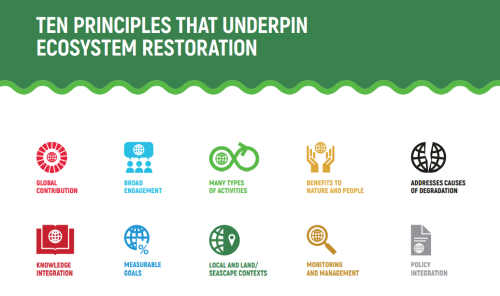
It’s laid out with “Ten Principles that Underpin Ecosystem Restoration”. Let’s just talk about four of the ten.
Principle 1: Global Contribution. Of course they’re talking about a global effort under the leadership of the United Nations. Principle 2: Broad Engagement. Everyone is involved, especially “under-represented” groups. Who decides who is most under-represented? You can guess, but they do give some examples: “local communities, Indigenous peoples, ethnic minorities, women, youth and LGBTIQ+ people”.
It’s hard to argue with the fact that we need everyone working together to care for the planet, right? But there’s more.
I listened to the interreligious panel that was held at COP26. And one of the panellists, from the Christian tradition, explained it like this.
“Our problem is that we have focused on personal responsibility. But often this doesn’t work, because people don’t have the ability. (Poor them.) And so, what we need to do is change the system, to have control from top down. Instead of focusing on personal responsibility, we should focus on social justice. For example, transfer funds from rich countries to people with a darker colour of skin. Et cetera.”
Of course, that was a rather loose paraphrase, but an accurate one. 🙂 So we’re back talking about “social justice”, from our discussion of justice. And now you’re going to hear the phrase “climate justice”, which actually is not biblical justice. In other words, the answer to our climate problem is not so much that you should drive your car less. The answer looks more like neo-marxism. It is the intelligent and powerful who decide who should get the money and how the systems should be set up.
Do you see how so much we’ve learned comes together here?
So how are we going to convince the common people of these things? Well, fear works. Terrible things will happen if you don’t listen to the “experts”. But should that kind of fear be our motivation, as Christians?
Principle 4: Benefits to Nature and People.“Ecosystem restoration aims to achieve and sustain the greatest net gain possible, given project- and programme-level goals, for biodiversity, ecosystem health and integrity, ecosystem goods and services, climate-change mitigation, and human health . . .”
Well, nice of them to throw “human health” in there at the very end.
It’s pretty common to give humanity a low priority here. Many people believe that the human population needs to be far lower than it is today. I’ve heard it preached that we should aim for between 500 million and 3 billion people in the world, and no more. Many base their estimates on the work of Paul Ehrlich from the University of Stanford.
And so birth control is promoted, and sterilization. The late David Graber, a biologist with the United States National Park Services, wrote in 1989: “Until such time as Homo sapiens should decide to rejoin nature, some of us can only hope for the right virus to come along.”
And actually, quite a few people have said similar things, in perhaps unguarded moments. Normally, it’s kept a little more quiet. But the truth is, there are many people looking for ways to decrease the human population as soon as possible (actually, as I write this now, I heard a popular news broadcast this morning talking about that very thing!). Why? Because “we’re in a crisis”. But – how does this perspective fit with God’s Law?
One more. Principle 6: Knowledge Integration.“Ecosystem restoration should strive to integrate all types of knowledge – including, but not limited to, Indigenous, traditional, local and scientific ways of knowing – and practices in order to achieve greater kinship with nature, cooperation and effectiveness.”
Now, listen carefully. Because this is also very common. This does not mean that we need information from everyone, because you know things that I don’t. This doesn’t mean that we need different perspectives on a problem. I would agree with both of those ideas. No, this is saying that we need to introduce new ways of knowing.
In other words, we don’t need to use the scientific method, logic, or absolute truth. Science is only one possible thing on the list! Because there are many “ways of knowing”. Paganism is quite popular, for example. So, we’ll decide what to call “truth”. What way to follow. Or more accurately, what to follow in place of the truth.
Are there good things in this document? Sure. But what has been smuggled in along with the good things? Denying God’s truth, and bringing in your own ways of knowing. Shaking your fist at God’s law. Devaluing the importance of human life. Ensuring that certain very “wise” people are in control.
In 2014, Dr. Joe Boot wrote about the difference between a humanist worldview, or we could say a secular humanist worldview (which has been common to some extent since the serpent told the woman that she could be like God), and a Christian worldview.
In a Christian worldview, God limits government. All people and institutions should have limits, because we’re sinners. If we don’t have limits, if we have too much power, what happens? We take more. These limits come from God, Someone apart from the creation. The transcendent God.
Dr. Boot writes:
…the pagan philosophers and statesmen favored statism, emperor worship and tyranny. One reason for this, as we have noted, was that their humanistic worldview (as with all humanism and paganism today) posited an ultimate impersonalism in which man is conditioned by an impersonal environment and not by a personal God. Whilst claiming to be free, in the world of flux, man was seen as conditioned by the stars, his family, his fortunes, nature and the gods (also products of nature and natural forces), and so he became fatalistic in his thinking. As such, pagan thought requires a powerful and priestly state to save man from the environment all around him…
In other words, in the real world, a person is free because he or she is made in God’s image, and is responsible to Someone outside of the universe. But in secular humanism, the person is conditioned by his or her environment, a perspective leading to fatalism, so that true freedom is impossible. We must be coerced into action by the emperor-priest.
Listen to people talking about environmentalism. You will hear religious language. The end of the world, salvation, repentance, it’s all there. But – it’s not the true religion.
So the answer of the world to environmental issues is to create a system to put you in a smaller box. Don’t worry, you can have freedom in your box, but the government will limit you and take care of you as it wishes. And you must believe that the box makes sense, the box is all that there is, the box is the only thing that is important for you.
Beyond questions of world temperatures and snowfall and sea levels are issues that are even more concerning for believers – a host of ideas that are being imported under the guise of caring for the planet.
Many non-Christians are doing good things for the environment. Thank God! And sometimes we can work together. But always remember, Christ is the Lord of Creation. He is the truth. So – ask questions. Research. Don’t be afraid to be different. Take personal responsibility. And don’t be surprised if you end up doing something that the world hates. Jesus warned you.
We’ll take one more brief post to wrap up this discussion, before taking a look back over all 11 topics that we’ve covered.
Our look at Biblical Anthropology continues today as we study some principles for caring for the environment. Let’s see what we can discover…
We’ve already looked at some general principles in Genesis. “work it and keep it” – “Be fruitful and multiply” – “subdue it, and have dominion” You can read the previous articles for more on those.
We can also find some principles in the Law of Moses, so let’s go there next.
One example is found in the laws of the Sabbath. In Leviticus 25, we find some important agricultural regulations for Israel:
The LORD spoke to Moses on Mount Sinai, saying, “Speak to the people of Israel and say to them, When you come into the land that I give you, the land shall keep a Sabbath to the LORD. For six years you shall sow your field, and for six years you shall prune your vineyard and gather in its fruits, but in the seventh year there shall be a Sabbath of solemn rest for the land, a Sabbath to the LORD. You shall not sow your field or prune your vineyard. You shall not reap what grows of itself in your harvest, or gather the grapes of your undressed vine. It shall be a year of solemn rest for the land. The Sabbath of the land shall provide food for you, for yourself and for your male and female slaves and for your hired worker and the sojourner who lives with you, and for your cattle and for the wild animals that are in your land: all its yield shall be for food.
Leviticus 25:1-7
After this, there would be a special year of rest, every 50 years. We’ve already talked a little about this when we studied justice.
Therefore you shall do my statutes and keep my rules and perform them, and then you will dwell in the land securely. The land will yield its fruit, and you will eat your fill and dwell in it securely. And if you say, ‘What shall we eat in the seventh year, if we may not sow or gather in our crop?’ I will command my blessing on you in the sixth year, so that it will produce a crop sufficient for three years. When you sow in the eighth year, you will be eating some of the old crop; you shall eat the old until the ninth year, when its crop arrives.
Leviticus 25:18-22
We see two purposes here – food itself, “you will eat your fill”, and security. This system cares for the poor, and it also provides for you.
And here’s something interesting – there is a supernatural element here. God promised the Israelites a larger crop every six years, so that there would be enough for the seventh year – a year of rest. We’ll talk more about this later.
Today we know from scientific study that the earth – the soil – does indeed need “rest”. Overuse can permanently damage the soil, even leading to desertification. Basically, converting fertile soil into a desert. God is wise.
Another fascinating law is a law about sieges in Deuteronomy 20. Basically, when you’re conquering a city (remember, the Israelites were about to enter Canaan), your army could cut down trees for weapons or fuel, but it was not permitted to cut down fruit trees. In other words, at the end of the war, you didn’t want everyone to die of hunger. (Take a look through history – how many times has that exact thing happened?)
There are also various laws for animals. Here are some quick examples.
If you see the donkey of one who hates you lying down under its burden, you shall refrain from leaving him with it; you shall rescue it with him.
Exodus 23:5
That one’s pretty simple. Help your neighbour, help his donkey. Even if your neighbour hates you.
You shall not muzzle an ox when it is treading out the grain…
Deuteronomy 25:4
Why? Because your cattle need the strength to do the work. This law is good for you, good for the ox.
If you come across a bird’s nest in any tree or on the ground, with young ones or eggs and the mother sitting on the young or on the eggs, you shall not take the mother with the young. You shall let the mother go, but the young you may take for yourself, that it may go well with you, and that you may live long.
Deuteronomy 22:6-7
This is an interesting one, and no explanation is given. But we can make some educated guesses.
There are a couple of reasons why you may want to take the young birds or the eggs. First, for food (or maybe for the feathers). That is allowed. Second, population control. If there is a huge population boom of a certain species, that can cause major problems in the ecosystem. This is a way to control population growth.
But – “let the mother go”, so that the species may not be wiped out completely. If you kill too many birds, what have you got? Snakes, scorpions, and everything else that the birdies eat.
So yes, go ahead and eat eggs and birds and control the population, but you still need to allow for a balanced ecosystem. God is wise.
What is the only explanation for this in the text? “…that it may go well with you, and that you may live long.” Keep that in mind as we continue our study.
Let’s look at a couple more principles in Proverbs.
Whoever is righteous has regard for the life of his beast, but the mercy of the wicked is cruel.
Proverbs 12:10
Don’t be cruel. Take care of your cow or your donkey.
Know well the condition of your flocks, and give attention to your herds, for riches do not last forever; and does a crown endure to all generations?
Proverbs 27:23-24
Why should you pay attention to the condition of your flocks? Because you’re preparing for the future. It’s as if someone were to say, “I don’t need to save money. I have a great job!” or “I don’t need to eat nutritious food, I’m healthy!” No – you should be thinking of the future, and preparing for it.
Let’s just stop at look at four principles that we can draw from our study so far:
We care for creation for the glory of God.
We care for creation to benefit people (quality and length of life).
Remember that phrase? “…that it may go well with you, and that you may live long.” So that the soil is productive, and so that our community is secure. These laws are very focused on human beings, the family, the community.
Take care of the garden, expand it, for food and – in a fallen world – medicine and general well-being.
You might have noticed something else. These are very local laws. In other words, you are especially responsible for yourself and your family.
This is a very interesting point. Now, of course, we have to admit that the world has changed a lot. Most of us don’t live on farms. And that raises a lot of other questions – like how should we be setting up our communities and our families? But I think that the Bible does emphasize for us the importance of our own geographical area, our own homes, our own community. Local responsibility.
So the next principle is:
We care for creation through local responsibility.
Finally, we have noted this supernatural element. God Himself blesses the earth.
We already discussed how God Himself cares for and sustains His creation. We’ve also learned that following wise principles tends to lead to abundance. This is simple logic. God has even more scientific knowledge than we do.
And so the fourth principle, obedience to God also brings blessing.
We care for creation through our general obedience to God.
This principle is all throughout Scripture, but here’s an example.
And because you listen to these rules and keep and do them, the LORD your God will keep with you the covenant and the steadfast love that he swore to your fathers. He will love you, bless you, and multiply you. He will also bless the fruit of your womb and the fruit of your ground, your grain and your wine and your oil, the increase of your herds and the young of your flock, in the land that he swore to your fathers to give you. You shall be blessed above all peoples. There shall not be male or female barren among you or among your livestock.
Deuteronomy 7:12-14
You might object that this is for Israel, not for us. You raise a good point. There are certainly special and specific promises in the Bible for the land of Israel. A covenant with a nation.
But I think there’s a universal principle here. Why?
Because we’re still talking about some of the same things we’ve been talking about since Genesis 1, things that apply to all humanity. Caring for the earth. Obeying God. Having children. “By his blessing they multiply greatly, and he does not let their livestock diminish” Psalm 107:38.
God is still in control of His creation. And yes, we have a certain amount of control over our environment. But many things happen on our planet and in our solar system that we simply cannot change.
We don’t have the same land promises as Israel had. And we all know that God chooses when we live, when we die, what sufferings we’ll go through. But He still sends us many physical blessings. He still sends physical judgements as well – and we suffer physical consequences if we are disobedient.
In reality, a couple of things are happening. First, the logical consequences of our actions. And it’s amazing how many things are connected together. Sometimes, ignoring the proper role of government, or not properly training our children, or sexual immorality, can have direct or indirect consequences when it comes to the environment.
But God may also choose to bring blessing or judgement to the earth – the planet – directly in answer to our actions.
Even before the Law of Moses, God said this to Cain:
The voice of your brother’s blood is crying to me from the ground. And now you are cursed from the ground, which has opened its mouth to receive your brother’s blood from your hand. When you work the ground, it shall no longer yield to you its strength.
From Genesis 4:10-12
A connection between murder and the environment?
And again, before the Law of Moses, the nations in Canaan were condemned for their immorality. Here’s what God said about that:
Do not make yourselves unclean by any of these things, for by all these the nations I am driving out before you have become unclean, and the land became unclean, so that I punished its iniquity, and the land vomited out its inhabitants.
Leviticus 18:24-25
The land, the land, the land “vomited out its inhabitants”.
And so this has led me to a surprising conclusion. What is the very best thing we can do to care for our planet? How should we celebrate Earth Day? Obey God’s Word. Not just the parts about the environment – all of it. General obedience.
Once again, we’re ending up at a very different place than the world ends up. I warned you!
But now that we have a biblical foundation, let’s take a look at some of the things that the world is promoting regarding the environment. What I found interesting about this is how so many themes from all of the Biblical Anthropology topics actually come together when we get into environmentalism. But we’ll get into that next time. 🙂
Last time we talked about the environment in Genesis 1 and 2 – at the beginning of creation, in a perfect world. But we all know that the world didn’t stay that way. So let’s move on to Genesis 3.
The basic history – the first man and woman rebelled against the Creator. And so God Himself placed His creation under a curse. Let’s see what God said…
To the woman he said, “I will surely multiply your pain in childbearing; in pain you shall bring forth children. Your desire shall be contrary to your husband, but he shall rule over you.” And to Adam he said, “Because you have listened to the voice of your wife and have eaten of the tree of which I commanded you, ‘You shall not eat of it,’ cursed is the ground because of you; in pain you shall eat of it all the days of your life; thorns and thistles it shall bring forth for you; and you shall eat the plants of the field. By the sweat of your face you shall eat bread, till you return to the ground, for out of it you were taken; for you are dust, and to dust you shall return.”
Genesis 3:16-19
Notice what happens here. God’s purpose continues, but it is now under a curse. What has changed?
Purpose: “Be fruitful and multiply” – but now “in pain you shall bring forth children”
Purpose:“subdue [the earth], and have dominion” but now there is “enmity” (Gen 3:15 – speaking of the serpent, but this is part of the conflict between humans and their environment) and “cursed is the ground because of you; in pain you shall eat of it all the days of your life … By the sweat of your face you shall eat bread”
Purpose:“fill the earth” but now, all will die (return to dust)
Purpose: Humans were in the garden to “work it and keep it” – but now they would be expelled from Eden (Gen 3:23-24)
There is another major worldwide change that we need to look at – the Flood. Here’s what God tells the new “first family”:
And God blessed Noah and his sons and said to them, “Be fruitful and multiply and fill the earth. The fear of you and the dread of you shall be upon every beast of the earth and upon every bird of the heavens, upon everything that creeps on the ground and all the fish of the sea. Into your hand they are delivered. Every moving thing that lives shall be food for you. And as I gave you the green plants, I give you everything. But you shall not eat flesh with its life, that is, its blood…”
Genesis 9:1-4
Here’s a change – now people were allowed to eat meat as well as plants. It’s not wrong to kill an animal and eat it. But killing a human is entirely different. Why?
…And for your lifeblood I will require a reckoning: from every beast I will require it and from man. From his fellow man I will require a reckoning for the life of man. Whoever sheds the blood of man, by man shall his blood be shed, for God made man in his own image. And you, be fruitful and multiply, increase greatly on the earth and multiply in it.
Genesis 9:5-7
Murder and justice. And once again it is confirmed that we are to fill the earth. Later in the chapter, we learn that we can have families, confident that God is not about to send another worldwide flood.
So, we have some instructions. We also know that there is an even more basic purpose in the creation, as the Westminster Shorter Catechism correctly states: “Man’s chief end is to glorify God, and to enjoy him forever.”
For from him and through him and to him are all things. To him be glory forever. Amen.
Romans 11:36
So, whether you eat or drink, or whatever you do, do all to the glory of God.
1 Corinthians 10:31
So we need to keep some of these basics in mind as we look to see what else the Bible has to say about the environment. And I have to admit, I found some things that surprised me.
Let’s actually start at the end. We know that the creation is under a curse. But what does the end of our current history look like?
In Romans chapter 8, Paul is teaching that, although we’re already redeemed, we still suffer in this present world.
For the creation was subjected to futility, not willingly, but because of him who subjected it, in hope that the creation itself will be set free from its bondage to corruption and obtain the freedom of the glory of the children of God. For we know that the whole creation has been groaning together in the pains of childbirth until now. And not only the creation, but we ourselves, who have the firstfruits of the Spirit, groan inwardly as we wait eagerly for adoption as sons, the redemption of our bodies.
Romans 8:20-23
Redemption is coming, glory and freedom, not just for us as believers, but for all of creation.
Let’s see what the Apostle Peter has to say. In his second epistle, Peter is talking about those who mock believers, denying that the final judgement is coming.
For they deliberately overlook this fact, that the heavens existed long ago, and the earth was formed out of water and through water by the word of God, and that by means of these the world that then existed was deluged with water and perished. But by the same word the heavens and earth that now exist are stored up for fire, being kept until the day of judgment and destruction of the ungodly. … Since all these things are thus to be dissolved, what sort of people ought you to be in lives of holiness and godliness, waiting for and hastening the coming of the day of God, because of which the heavens will be set on fire and dissolved, and the heavenly bodies will melt as they burn! But according to his promise we are waiting for new heavens and a new earth in which righteousness dwells.
2 Peter 3:5-7,11-13
And so, how will God renew His universe? He’s going to destroy it, and remake it. The final destruction of fire doesn’t appear to come from humans, but from the hand of God. And so in Revelation 21 we read “Then I saw a new heaven and a new earth, for the first heaven and the first earth had passed away…” (Rev 21:1).
All of this is temporary. The shirt I’m wearing is temporary too. But I’m still going to wash it and take care of it. But I understand that it has a temporary purpose.
In the meantime, God has promised to sustain the basic cycles of the earth. Yahweh says in Genesis 8:22, “While the earth remains, seedtime and harvest, cold and heat, summer and winter, day and night, shall not cease.”
Think about this carefully, because I’ve heard some confusion about this. This promise of God is not saying that the earth will never get warmer or cooler, or become polluted, or that there will never be any natural disasters, or that a species will never become extinct. This verse does not say that there will be no consequences if we do not care for the earth.
However, it does promise that God will sustain the general cycles of the earth and care for humanity in general. We don’t fear complete environmental destruction from human activity. We know how history will end.
Two important facts from Scripture: (1) God tells us to care for the earth. (2) God Himself cares for the earth, and also judges the earth, as its Sovereign King.
How exactly are we to care for the earth? Actually, the Bible gives us some very helpful guidance. We’ll dive into some specifics next time…