Even those unfamiliar with the Authorized Version (King James) of the Bible might know this archaic word. After all, even today many people know the story of the angels and shepherds in Old English:
And there were in the same country shepherds abiding in the field, keeping watch over their flock by night. And, lo, the angel of the Lord came upon them, and the glory of the Lord shone round about them: and they were sore afraid.
Luke 2:8-9 (AV)
Lo! Another translation of the word has carried over into some modern translations, because it’s hard to find a more contemporary word that is as accurate – Behold!
“Lo!” may actually be a short form of “look!”. The idea is just that – “Look!” “Pay attention to this!” “Unbelievable, but true…”
The word appears often in the Christmas story. Here’s just a sample:
“And behold, you will conceive in your womb and bear a son, and you shall name Him Jesus.” (Luke 1:31)
“Behold, a virgin shall be with child, and shall bring forth a son, and they shall call his name Emmanuel, which being interpreted is, God with us.” (Matthew 1:23)
“But the angel said to them, ‘Do not be afraid; for behold, I bring you good news of great joy which will be for all the people…'” (Luke 2:10)
“Now after hearing the king, they went their way; and behold, the star, which they had seen in the east, was going on before them until it came and stood over the place where the Child was.” (Matthew 2:9)
But the word also appears at the end of the story. When the resurrection happens, of course. But before that, when Jesus is talking about the cross. The fact that He, the Lord, would be betrayed and bound and crucified was in many ways “unbelievable but true”.
And He came the third time, and said to them, “Are you still sleeping and resting? It is enough; the hour has come; behold, the Son of Man is being betrayed into the hands of sinners…”
Mark 14:41
Hanby has been writing about the humility of the Saviour, the compassion of the Saviour. But – wait! Look! Sorrow, and pain – so undeserved.
Lo! at midnight, who is He Prays in dark Gethsemane? Who is He on yonder tree Dies in grief and agony?
The first shock of the song was that Jesus was born in humble circumstances. The second shock is that He dies in grief.
Often in New Testament Greek the cross is referred to as the “tree”. Some English translations make this clear, but others do not. A tree was a place of testing in the Garden of Eden. The Tree of Life was taken away because of the curse. (Genesis 3) The tree became a place of curse (Deuteronomy 21:22-23). Jesus became a curse for us on a tree (Galatians 3:13). Because of His death on a tree, the Tree of Life is restored to us (Revelation 2:7).
Now the tree represents new life for us. But most did not understand at the time, when Jesus was hung up on the “tree”, that this was the great “Lo!” of history – the moment that all must look to – the cursing that brought blessing. The grief that brought eternal joy (Hebrews 12:2).
And His obedience in His death leads to eternal worship.
Worthy is the Lamb that was slain to receive power and riches and wisdom and strength and honor and glory and blessing.
Our look at Biblical Anthropology continues today as we study some principles for caring for the environment. Let’s see what we can discover…
We’ve already looked at some general principles in Genesis. “work it and keep it” – “Be fruitful and multiply” – “subdue it, and have dominion” You can read the previous articles for more on those.
We can also find some principles in the Law of Moses, so let’s go there next.
One example is found in the laws of the Sabbath. In Leviticus 25, we find some important agricultural regulations for Israel:
The LORD spoke to Moses on Mount Sinai, saying, “Speak to the people of Israel and say to them, When you come into the land that I give you, the land shall keep a Sabbath to the LORD. For six years you shall sow your field, and for six years you shall prune your vineyard and gather in its fruits, but in the seventh year there shall be a Sabbath of solemn rest for the land, a Sabbath to the LORD. You shall not sow your field or prune your vineyard. You shall not reap what grows of itself in your harvest, or gather the grapes of your undressed vine. It shall be a year of solemn rest for the land. The Sabbath of the land shall provide food for you, for yourself and for your male and female slaves and for your hired worker and the sojourner who lives with you, and for your cattle and for the wild animals that are in your land: all its yield shall be for food.
Leviticus 25:1-7
After this, there would be a special year of rest, every 50 years. We’ve already talked a little about this when we studied justice.
Therefore you shall do my statutes and keep my rules and perform them, and then you will dwell in the land securely. The land will yield its fruit, and you will eat your fill and dwell in it securely. And if you say, ‘What shall we eat in the seventh year, if we may not sow or gather in our crop?’ I will command my blessing on you in the sixth year, so that it will produce a crop sufficient for three years. When you sow in the eighth year, you will be eating some of the old crop; you shall eat the old until the ninth year, when its crop arrives.
Leviticus 25:18-22
We see two purposes here – food itself, “you will eat your fill”, and security. This system cares for the poor, and it also provides for you.
And here’s something interesting – there is a supernatural element here. God promised the Israelites a larger crop every six years, so that there would be enough for the seventh year – a year of rest. We’ll talk more about this later.
Today we know from scientific study that the earth – the soil – does indeed need “rest”. Overuse can permanently damage the soil, even leading to desertification. Basically, converting fertile soil into a desert. God is wise.
Another fascinating law is a law about sieges in Deuteronomy 20. Basically, when you’re conquering a city (remember, the Israelites were about to enter Canaan), your army could cut down trees for weapons or fuel, but it was not permitted to cut down fruit trees. In other words, at the end of the war, you didn’t want everyone to die of hunger. (Take a look through history – how many times has that exact thing happened?)
There are also various laws for animals. Here are some quick examples.
If you see the donkey of one who hates you lying down under its burden, you shall refrain from leaving him with it; you shall rescue it with him.
Exodus 23:5
That one’s pretty simple. Help your neighbour, help his donkey. Even if your neighbour hates you.
You shall not muzzle an ox when it is treading out the grain…
Deuteronomy 25:4
Why? Because your cattle need the strength to do the work. This law is good for you, good for the ox.
If you come across a bird’s nest in any tree or on the ground, with young ones or eggs and the mother sitting on the young or on the eggs, you shall not take the mother with the young. You shall let the mother go, but the young you may take for yourself, that it may go well with you, and that you may live long.
Deuteronomy 22:6-7
This is an interesting one, and no explanation is given. But we can make some educated guesses.
There are a couple of reasons why you may want to take the young birds or the eggs. First, for food (or maybe for the feathers). That is allowed. Second, population control. If there is a huge population boom of a certain species, that can cause major problems in the ecosystem. This is a way to control population growth.
But – “let the mother go”, so that the species may not be wiped out completely. If you kill too many birds, what have you got? Snakes, scorpions, and everything else that the birdies eat.
So yes, go ahead and eat eggs and birds and control the population, but you still need to allow for a balanced ecosystem. God is wise.
What is the only explanation for this in the text? “…that it may go well with you, and that you may live long.” Keep that in mind as we continue our study.
Let’s look at a couple more principles in Proverbs.
Whoever is righteous has regard for the life of his beast, but the mercy of the wicked is cruel.
Proverbs 12:10
Don’t be cruel. Take care of your cow or your donkey.
Know well the condition of your flocks, and give attention to your herds, for riches do not last forever; and does a crown endure to all generations?
Proverbs 27:23-24
Why should you pay attention to the condition of your flocks? Because you’re preparing for the future. It’s as if someone were to say, “I don’t need to save money. I have a great job!” or “I don’t need to eat nutritious food, I’m healthy!” No – you should be thinking of the future, and preparing for it.
Let’s just stop at look at four principles that we can draw from our study so far:
We care for creation for the glory of God.
We care for creation to benefit people (quality and length of life).
Remember that phrase? “…that it may go well with you, and that you may live long.” So that the soil is productive, and so that our community is secure. These laws are very focused on human beings, the family, the community.
Take care of the garden, expand it, for food and – in a fallen world – medicine and general well-being.
You might have noticed something else. These are very local laws. In other words, you are especially responsible for yourself and your family.
This is a very interesting point. Now, of course, we have to admit that the world has changed a lot. Most of us don’t live on farms. And that raises a lot of other questions – like how should we be setting up our communities and our families? But I think that the Bible does emphasize for us the importance of our own geographical area, our own homes, our own community. Local responsibility.
So the next principle is:
We care for creation through local responsibility.
Finally, we have noted this supernatural element. God Himself blesses the earth.
We already discussed how God Himself cares for and sustains His creation. We’ve also learned that following wise principles tends to lead to abundance. This is simple logic. God has even more scientific knowledge than we do.
And so the fourth principle, obedience to God also brings blessing.
We care for creation through our general obedience to God.
This principle is all throughout Scripture, but here’s an example.
And because you listen to these rules and keep and do them, the LORD your God will keep with you the covenant and the steadfast love that he swore to your fathers. He will love you, bless you, and multiply you. He will also bless the fruit of your womb and the fruit of your ground, your grain and your wine and your oil, the increase of your herds and the young of your flock, in the land that he swore to your fathers to give you. You shall be blessed above all peoples. There shall not be male or female barren among you or among your livestock.
Deuteronomy 7:12-14
You might object that this is for Israel, not for us. You raise a good point. There are certainly special and specific promises in the Bible for the land of Israel. A covenant with a nation.
But I think there’s a universal principle here. Why?
Because we’re still talking about some of the same things we’ve been talking about since Genesis 1, things that apply to all humanity. Caring for the earth. Obeying God. Having children. “By his blessing they multiply greatly, and he does not let their livestock diminish” Psalm 107:38.
God is still in control of His creation. And yes, we have a certain amount of control over our environment. But many things happen on our planet and in our solar system that we simply cannot change.
We don’t have the same land promises as Israel had. And we all know that God chooses when we live, when we die, what sufferings we’ll go through. But He still sends us many physical blessings. He still sends physical judgements as well – and we suffer physical consequences if we are disobedient.
In reality, a couple of things are happening. First, the logical consequences of our actions. And it’s amazing how many things are connected together. Sometimes, ignoring the proper role of government, or not properly training our children, or sexual immorality, can have direct or indirect consequences when it comes to the environment.
But God may also choose to bring blessing or judgement to the earth – the planet – directly in answer to our actions.
Even before the Law of Moses, God said this to Cain:
The voice of your brother’s blood is crying to me from the ground. And now you are cursed from the ground, which has opened its mouth to receive your brother’s blood from your hand. When you work the ground, it shall no longer yield to you its strength.
From Genesis 4:10-12
A connection between murder and the environment?
And again, before the Law of Moses, the nations in Canaan were condemned for their immorality. Here’s what God said about that:
Do not make yourselves unclean by any of these things, for by all these the nations I am driving out before you have become unclean, and the land became unclean, so that I punished its iniquity, and the land vomited out its inhabitants.
Leviticus 18:24-25
The land, the land, the land “vomited out its inhabitants”.
And so this has led me to a surprising conclusion. What is the very best thing we can do to care for our planet? How should we celebrate Earth Day? Obey God’s Word. Not just the parts about the environment – all of it. General obedience.
Once again, we’re ending up at a very different place than the world ends up. I warned you!
But now that we have a biblical foundation, let’s take a look at some of the things that the world is promoting regarding the environment. What I found interesting about this is how so many themes from all of the Biblical Anthropology topics actually come together when we get into environmentalism. But we’ll get into that next time. 🙂
When we think about “art”, we’re often thinking about the fine arts like painting and sculptures. Which, for the Christian, might bring to mind “images” from the second of the Ten Commandments –
You shall not make for yourself a carved image, or any likeness of anything that is in heaven above, or that is in the earth beneath, or that is in the water under the earth.
Exodus 20:4
If God is literally telling us not to ever make any image of anything, that would restrict our art significantly!
The translation “carved image” is accurate – this would be an image carved of wood or stone.
This has been a huge controversy in church history, particularly when it comes to pictures or sculptures depicting God, or other religious images such as angels or saints. The arguments became very complicated. Some suggested that a sculpture was sinful, but a two-dimensional icon was all right. I even remember hearing – could someone find the source for me? – that at one point there was a “nose-pinch” test. If the image was three-dimensional enough that you could pinch its nose, it was a sinful image.
I’m not going to get into all of that today! But there are some people who have argued that we shouldn’t have any visual art at all that represents anything in the creation. No photos, no paintings, nothing.
But context is a wonderful thing, and the next verse does clarify what this commandment is all about:
You shall not bow down to them or serve them, for I the LORD your God am a jealous God, visiting the iniquity of the fathers on the children to the third and the fourth generation of those who hate me…
Exodus 20:5
God isn’t talking about any image, but a religious image that you would bow down to – an idol. Deuteronomy also clarifies the issue:
You shall not make for yourself a carved image, or any likeness of anything that is in heaven above, or that is on the earth beneath, or that is in the water under the earth. You shall not bow down to them or serve them; for I the LORD your God am a jealous God, visiting the iniquity of the fathers on the children to the third and fourth generation of those who hate me, but showing steadfast love to thousands of those who love me and keep my commandments.
Deuteronomy 5:8-10
It is prohibited to worship an idol, says Moses. If you serve an idol, that’s a sin. In fact, even if you bow or kneel to an image, you’re breaking this commandment –
…that you may not mix with these nations remaining among you or make mention of the names of their gods or swear by them or serve them or bow down to them…
Joshua 23:7
The problem is not the sculpture in itself. But the problem is the sculpture when it is created as an object of worship.
It’s also a sin to create an image representing the true God. You might remember that the Israelites had a name for their golden calf idol – it was “Yahweh” (Jehovah). But the Holy Spirit said through Moses:
Therefore watch yourselves very carefully. Since you saw no form on the day that the LORD spoke to you at Horeb out of the midst of the fire, beware lest you act corruptly by making a carved image for yourselves, in the form of any figure, the likeness of male or female, the likeness of any animal that is on the earth, the likeness of any winged bird that flies in the air, the likeness of anything that creeps on the ground, the likeness of any fish that is in the water under the earth..
Deuteronomy 4:15-18
These verses don’t condemn art in general, but idolatry, and physical representations of the invisible God to worship.
But there’s another reason why we know that the second commandment is not against art in general. The Tabernacle.
The Tabernacle, according to God’s own instructions, was filled with works of art.
For example, do you remember what was above the Ark of the Covenant? “Two cherubim of gold”. A cherub is a kind of angel.
It makes you wonder – did God describe what cherubim look like to the artist? Maybe – but of course they are spiritual creatures. Real cherubim aren’t made of gold. This was, in the end, an artistic representation of something spiritual.
A study of the Tabernacle – and the Temple – is a fascinating look at how God views art. Let’s take some time in the next part of our study to look closer at the kinds of art that we see in the Old Testament.
Let’s take the time to apply some of what we’ve learned about justice and partiality. Now, we recognize that justice is applied in different ways in our personal lives, at work, in the family, in the church, in the community, or in government.
But as we look through the Bible, let’s try to pull out some of the most common principles that can apply to all, and especially to our personal lives.
First, what if we experience partiality against ourselves? Someone is against you. Racism, or any kind of partiality. Against you because your a Christian. Whatever the case may be.
Well, maybe we could start by admitting this – yes, I am a bad person. Apart from Christ. I’m a sinner. I’m worse than you think. We start with humility.
(A) I admit my sinfulness. (Psalm 51:3-5; Luke 17:7-10; Romans 2:1)
Now listen – the world will call your good “evil”. Unjust? Yes. But in spite of that, we can admit that we are all sinners in need of a Saviour.
And then we say, I’m not going to “hate you back”. I’m not going to devalue you, because you did it to me. You were created in the image of God. I will be an example.
(B) I aim to conquer evil with good. (Matthew 5:44-46; Romans 12:21; 1 Peter 2:12)
And I aim to live a just and merciful life, and will encourage others to do the same.
(C) I aim to live a life of justice. (Micah 6:8; Matthew 5:15-16; Matthew 23:23)
I am responsible to promote justice and fight against partiality in my family, my church, and my community.
(D) I wait for God to defend me, and bring true and complete justice. (Deuteronomy 32:35-36; Psalm 37; Psalm 73; Romans 12:19)
God will vindicate you. God will defend you. The truth will be known.
Commit your way to the LORD; trust in him, and he will act. He will bring forth your righteousness as the light, and your justice as the noonday. … For the LORD loves justice; he will not forsake his saints. They are preserved forever, but the children of the wicked shall be cut off.
Psalm 37:5-6,28
In C and D, we see a contentment that acts. That is, we do not have a contentment, a peace, that is weak and passive. We have complete peace and contentment in God, and at the same time we fight the good fight of the Faith. A contentment armed with the sword of the Lord.
Now, let’s make a list of some of the ways in which God wants us to promote justice. And I encourage you to meditate on some of the extra verses I’m including, because the Spirit has a lot to teach us.
Don’t show partiality. Remember that everyone has value; they were created in the image of God. (Leviticus 19:15; Deuteronomy 1:17; 1 Timothy 5:21; James 2:1)
Be honest. Be careful with your words. Don’t gossip. Don’t slander. Look – this can be hard in times of conflict, because we want to find every excuse we can to fight against someone who may truly be evil. But we must always be careful to speak the truth. (Exodus 20:16; 2 Corinthians 12:20; Ephesians 4:25)
Remember that we are all responsible for our own actions. We’re neither innocent nor guilty because of our race, culture, or history. We’re not sin-free because we belong to a certain group. We are all personally responsible before God. (Ezekiel 18; Romans 2:1-4)
Be kind, merciful, and generous to the vulnerable. Those who have no family, or no family nearby. The poor. Those without influence and resources. (Exodus 22:21-27; Daniel 4:27; 2 Corinthians 8:1-5; James 1:27)
Never accept a bribe. (Exodus 23:8; Deuteronomy 16:19; Isaiah 33:14-16)
Study God’s Word, and obey with humility. (Psalm 19:7-11; Ezra 7:10; Micah 6:8; 1 John 2:4-6)
Be sure that the God of the Bible is your God, and worship Him only. Once again, this is contentment with a sword. We imitate what we worship, right?
The Rock, his work is perfect, for all his ways are justice. A God of faithfulness and without iniquity, just and upright is he.
Deuteronomy 32:4
And one more thing. I mentioned Jon Harris earlier. He is someone who has studied these things quite a bit. This is some wise counsel that he has given.
I’ve pointed out already that it’s very easy to give the impression that you’re promoting justice. It’s easy to post something on social media. It’s easy to complain about another group of people. Or say something against someone.
The world wants us to “love” in a very abstract way. There are oppressed people, and some of them are us, and so we join a protest, or we mock someone on social media.
But as believers, we should look around us and love real people directly, personally, and with generosity.
Start with your family, and with your local church. How often do you even smile at your family members? Once in a while, I hope. How often do you help someone else before they ask? How often do you simply surprise someone with your generosity? And look, I’m not just talking dollars here, although that’s important. Be generous with treasure, time and talent. Be sure to love with actions, not just words.
And after your family and church, try being friendly with that neighbour or classmate or coworker that you don’t like. Pray for someone specific. Show mercy and love to real, specific people that you know physically. Hey – give actual money to someone in need.
Live like the Lord Jesus.
A prayer to Yahweh:
My soul yearns for you in the night; my spirit within me earnestly seeks you. For when your judgments are in the earth, the inhabitants of the world learn righteousness.
Isaiah 26:9
Yahweh is exalted, for he dwells on high; he will fill Zion with justice and righteousness, and he will be the stability of your times, abundance of salvation, wisdom, and knowledge; the fear of Yahweh is Zion’s treasure.
Isaiah 33:5-6
Amen to that.
Additional Resources…
We’ve spent a long time talking about justice and partiality! Here are some additional resources to check out on both topics.
And by the way, I’ll be taking a break from the Biblical Anthropology series until after Christmas. We’re still going to talk about creativity (art) and communication, and also the environment. After that, we’ll try to pull everything together in a review. So we’ll get to that, Lord willing, in 2023.
It seems like we’ve spent many posts just doing an introduction. But let’s get to just a bit of what the Bible has to say about justice and partiality.
We’ve read this before, but let’s go back to Deuteronomy:
You shall appoint judges and officers in all your towns that the Lord your God is giving you, according to your tribes, and they shall judge the people with righteous judgment. You shall not pervert justice. You shall not show partiality, and you shall not accept a bribe, for a bribe blinds the eyes of the wise and subverts the cause of the righteous. Justice, and only justice, you shall follow, that you may live and inherit the land that the Lord your God is giving you.
Deuteronomy 16:18-20
Notice that first part – “judges and officers in all your towns”. Justice would be accessible, and probably fairly quick. And the judgements, of course, must be just – “righteous judgment”. That is, based on God’s law, God’s justice.
Justice here is not trying to make everyone equal. But everyone is equal before the law. “You shall not pervert justice. You shall not show partiality…” It doesn’t matter if the accused is male or female, king or slave, foreigner or national, rich or poor. If you steal, you give it back.
And why mention bribes? What is the problem with bribes? Simply this – bribes mean that the person with power and resources can obtain justice, and the poor person can’t. Or maybe the rich can break the law and escape because of a bribe. Yes, the rich do have a possible advantage here – the bribe. But God says NO – “you shall not accept a bribe”.
“Justice, and only justice, you shall follow…”
You shall not be partial in judgment. You shall hear the small and the great alike. You shall not be intimidated by anyone, for the judgment is God’s…
Deuteronomy 1:17a
You shall do no injustice in court. You shall not be partial to the poor or defer to the great, but in righteousness shall you judge your neighbor.
Leviticus 19:15
“Oh, but the poor are ‘oppressed’, and so we should give them the advantage.” No. The law should be equally applied to all.
Sometimes it’s more helpful if we use biblical terminology instead of the words and phrases of the world, like “racism” and “discrimination”. Terms like “partiality” and “favouritism” are more biblical terms (in English!).
Why does God only mention rich and poor? They are examples. What’s the main point? The law should apply to everyone equally. No government or expert should decide to change the law for certain people, oppressed or not.
But who is more likely to suffer from injustice? The poor. The vulnerable. Right? And so, the Bible tells us to help the poor. To ensure that they receive justice. And we personally help them as well.
We know that God loves His creation. And we also know that He specifically defends certain people – people we may call “vulnerable”. Let’s take a look at another text:
You shall not wrong a sojourner or oppress him, for you were sojourners in the land of Egypt. You shall not mistreat any widow or fatherless child. If you do mistreat them, and they cry out to me, I will surely hear their cry, and my wrath will burn, and I will kill you with the sword, and your wives shall become widows and your children fatherless. If you lend money to any of my people with you who is poor, you shall not be like a moneylender to him, and you shall not exact interest from him. If ever you take your neighbor’s cloak in pledge, you shall return it to him before the sun goes down, for that is his only covering, and it is his cloak for his body; in what else shall he sleep? And if he cries to me, I will hear, for I am compassionate.
Exodus 22:21-27
Do not mistreat the poor, the foreigner, the vulnerable. Don’t use them for your own benefit.
Here are a few more principles in the next chapter:
You shall not spread a false report. You shall not join hands with a wicked man to be a malicious witness. You shall not fall in with the many to do evil, nor shall you bear witness in a lawsuit, siding with the many, so as to pervert justice, nor shall you be partial to a poor man in his lawsuit.
Exodus 23:1-3
Always be honest. Speak the truth. Don’t be partial to the poor – but that’s only an example. What does it mean? Don’t be partial to anyone! Just be honest.
If you meet your enemy’s ox or his donkey going astray, you shall bring it back to him. If you see the donkey of one who hates you lying down under its burden, you shall refrain from leaving him with it; you shall rescue it with him.
Exodus 23:4-5
It doesn’t matter if you’re not really fond of your neighbour. You’re a part of the community. We help one another.
You shall not pervert the justice due to your poor in his lawsuit. Keep far from a false charge, and do not kill the innocent and righteous, for I will not acquit the wicked.
Exodus 23:6-7
This is an important principle. The law should protect the innocent. We talked about this before, but here it is in black and white. Two or three witnesses – and that means that sometimes the wicked will escape. But we protect the innocent and the righteous. Why? Because God “will not acquit the wicked”. In other words, “Vengeance is mine, I will repay, says the Lord.” (Romans 12.19) In other words, when the wicked escape, they don’t escape forever. God is just.
God’s Word is so wise – so just!
And you shall take no bribe, for a bribe blinds the clear-sighted and subverts the cause of those who are in the right. You shall not oppress a sojourner. You know the heart of a sojourner, for you were sojourners in the land of Egypt.
Exodus 23:8-9
We’ve already talked about that – let’s continue.
For six years you shall sow your land and gather in its yield, but the seventh year you shall let it rest and lie fallow, that the poor of your people may eat; and what they leave the beasts of the field may eat. You shall do likewise with your vineyard, and with your olive orchard. Six days you shall do your work, but on the seventh day you shall rest; that your ox and your donkey may have rest, and the son of your servant woman, and the alien, may be refreshed.
Exodus 23:10-12
This is great. There are laws in the Old Testament especially designed to protect the poor. Do you remember the law of gleaning? “And when you reap the harvest of your land, you shall not reap your field right up to its edge, nor shall you gather the gleanings after your harvest. You shall leave them for the poor and for the sojourner: I am the LORD your God.” (Leviticus 23:22)
God’s law provides for the vulnerable. We’re not supposed to grasp on to every dollar we can. We leave something for the poor. Generosity. And this is generosity with dignity – the poor still work, but they have work to do.
Exodus 23 is another example of this. Leave your field alone for a year. It’s good for the soil, the environment. The poor can take the “wild” produce. The cattle have something different to eat. It’s good for everyone. God’s Word – so wise!
And of course there’s a day of rest – for your family, for your animals, for the foreigners, employees, slaves, whoever it may be.
Simple principles. Be honest. Don’t accept bribes. Don’t use and abuse people. Be generous. Work hard, and rest.
Yes, people will judge you unjustly. But where is my heart? Where is yours?
Because partiality is not only against the poor, the disabled, or the foreigner. It’s against whomever you don’t like, whomever you decide to use and abuse.
So next time we’ll come a little closer to home, and look at our own hearts. Are we showing favouritism?
Who are we, as humans? We’re people who live in communities, in countries. People who desire justice.
I’m calling the next section of our study “Partiality”, and you’ll see why, but it’s basically a continuation of our study on justice. And in this section, we’ll be talking more about racism.
I imagine that most of us – maybe all of us – have experienced some kind of prejudice against us because of the colour of our skin, because of our faith, or because we’re not from “around here”, or because of our economic status.
The topic of equity or justice is very important – we could easily spend a year or two just on this topic. It’s important, and in a way very complex.
My hope, my goal, is that through this study we will see the incredible wisdom of God’s Word. But first, it’s important to understand more about the versions of “justice” that the world tries to sell us.
To start with, it may be helpful to clarify a couple of things.
In the first place, in this study we’re talking about many very current topics. And in taking on the topic of justice, or what the world thinks of as justice, remember that neither you nor I are experts. Why? Because the world is changing very quickly.
Now, of course, the truth of God’s Word never changes. And the majority of Satan’s lies are the same as always. But both are seen in different ways – or, we might say, applied in different ways – in different situations.
And so, on the one hand, we have a solid anchor in the Bible. Sometimes we notice that a child who simply believes what God says can see the lies better than an intelligent adult. “I have more understanding than all my teachers, for your testimonies are my meditation.” (Psalm 119:99)
At the same time, we all need to keep learning. Our enemy is clever and subtle. As Paul said, “we are not ignorant of his designs” (2 Corinthians 2:11). But yes, they are designs – schemes. Complicated.
Don’t forget about the house we talked about earlier! The lies always come mixed with truth. The lies are nothing – they’re not real. And so the enemy has constructed a house that is unstable, incomplete, in ruins. But from this, his headquarters, he still attacks.
In the last section we talked about Marxism. Marxism is an anti-christian philosophy that divides the world into two groups – the oppressed, and the oppressors. That’s the basis for the ideology of communism. And we’ll talk more about Marxism in this section.
But remember that every philosophy has its history, its roots. Marxism is only a part of the history of modern ideas of justice. It’s not the beginning of the story, nor is it the complete story. And so many who use ideas that are common in Marxism will deny that they’re Marxist, and may even claim that they are against Marxism. And if they’re in a Christian environment, they will use Christian terminology for their ideas.
Of course, some people admit their Marxist roots openly. As a recent example, the leaders of Black Lives Matter in the USA. They were listed by TIME Magazine as some of the most influential people in the world. One of the founders explained that they are trained Marxists. And also talked about invoking spirits – an involvement in the occult.
But there are indeed Christians making use of these ideas, who will deny any connection with Marxism. So why are we even bothering with this term?
Simply because it is a useful marker in history, a hook to hang our conversation on. Some may call modern ideas “neo-Marxism” – new Marxism. And from this come ideas such as liberation theology (so common in Latin America), social justice, critical race theory, and many related concepts.
Many believers have expressed concern about this stream of ideology for a while now. A well-known example, Pastor John MacArthur has said that the current ideas of social justice among Christians is the greatest danger to the church that he has seen in his lifetime. He, of course, is talking about the United States. But as many of you know, these ideas are all over the world, although sometimes they come in different forms.
And so what we’re doing here is taking very very complex ideas, and trying to simplify them into a manageable form. My hope is that we can take home some practical concepts that we can use in everyday life.
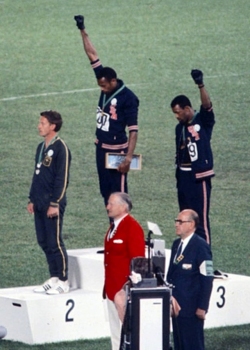
Often Marxist ideas are connected with a symbol – a symbol I’m sure you’ve seen: a raised fist. You see it everywhere if you take the time to look.
Mexico City 1968
This symbol was actually made famous in the Olympic Games in Mexico City in 1968, when two athletes from the USA raised their fists during the playing of their national anthem.
Now of course, no every time someone raises a fist is it related to some neo-Marxist ideology. But when you see the symbol, it’s not a bad idea to ask some questions.
Is there a division being made between oppressed and oppressor? Who is who? Are the ideas being promoted here biblical? Is someone asking a government or political party or other group to promote non-Christian ideas? Are these ideas promoting constant conflict and division? Is there a “revolution” being advocated here? (We’ve talked about many of these things earlier – be sure to read the series in order.)
And always remember – the lies will always be mixed with the truth. Remember the house.
And here’s another question to ask. What does this person or organization believe about sin?
Marxism advocates an idea known as the perfectibility of human nature. What’s that? The idea is that if we have proper systems in place, a properly organized society, if everyone had the same opportunities and resources, the world’s problems would disappear. The solution to the human problems is to improve the human environment – society, culture.
And so, what is said? Tell me if you’ve heard any of these phrases, or something similar. “This is for your safety, for your health.” “The poor children, suffering from racism, climate change, COVID-19…” “Look at all the disruptions in our world systems. We need to rebuild better.” All you must do is give us, the experts, the control. The problem isn’t the heart – it’s the social systems and institutions.
Ok, they may not exactly say that last part out loud. Or, they may.
As Christians, we know that this is not the solution. Why? Because humans are sinners. Don’t forget what Aleksandr Solzhenitsyn said (from an earlier post): “…the line dividing good and evil cuts through the heart of every human being.”
A human being can never be perfected, outside of a spiritual new birth. If there are unjust, unbiblical laws, we should be happy to fight against them. But evil will never be erased until the human heart changes. And so the final solution will never be a political party, a new law, a new system.
If our problem is that we don’t all have the same resources, that makes God Himself the evil oppressor. Listen:
Beware lest you say in your heart, ‘My power and the might of my hand have gotten me this wealth.’ You shall remember the LORD your God, for it is he who gives you power to get wealth, that he may confirm his covenant that he swore to your fathers, as it is this day.
Deuteronomy 8:17-18
Human perfectibility. For the neo-Marxists, we enter the world like a blank memory stick. And it is the culture, the government, and the systems that copy data onto that stick – good or evil, written onto our being. It’s not our fault – it’s the system. And that’s why we must burn it all down and create something new. That is the Marxist hope.
But as Christians, we know that we start life as sinners who need a Saviour – the Lord Jesus Christ.
And yet many people are attracted to this type of activism. Why? Because we all want justice! Right? We all want to do something. And we want to be seen as people who really are concerned about the oppressed – we want to be known as good people.
At the end of this section, we will try to get to some practical things that we can do. Because yes, action is very important. But we’ll leave it there for today, and get on to the topic of racism, etc., next time.