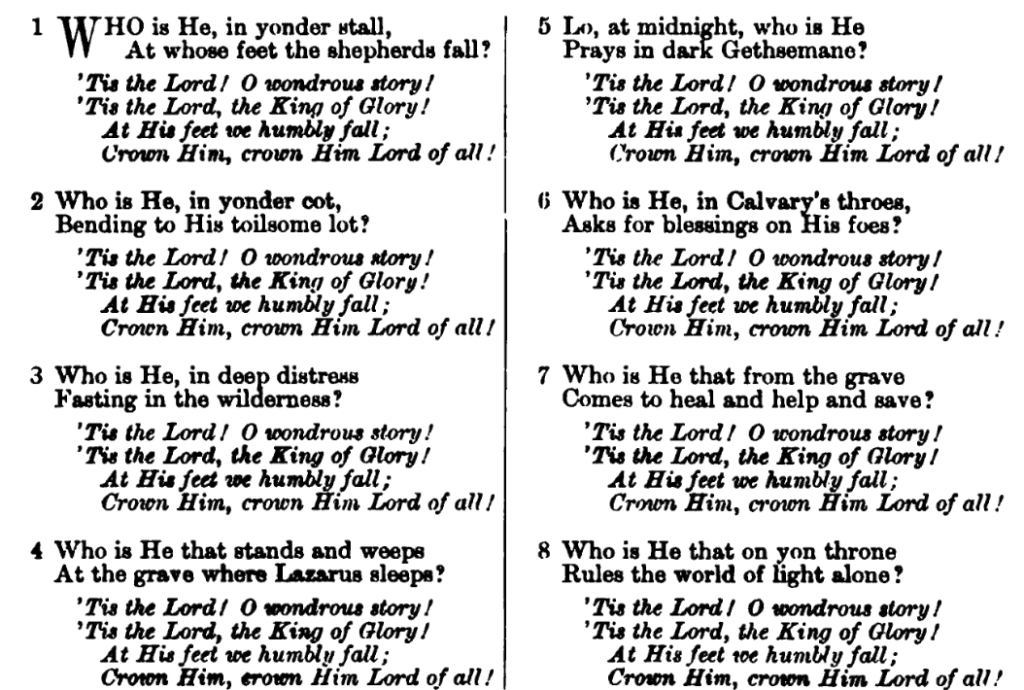
When Who is He in Yonder Stall? was first published, every verse was a couplet of its own, making 10 verses, almost all starting with “Who is He”. 90 years later, in 1956, in the Worship and Service Hymnal, Donald Hustad combined two couplets for each stanza, giving the song the form it has today.
My Dad found the song rather repetitive, and gave this suggestion for congregational singing:
To relieve the monotony, you might try having part of the congregation sing one line of a stanza, and another part of the congregation respond with the other. Then all could join in singing the chorus. It would also work to have two soloists sing the stanzas, and the congregation answer with the refrain.
Robert Cottrill
This change in the form of the song is worth remembering, because the two couplets are not necessarily meant to come as a pair. Nevertheless, here’s the next section that we’re looking at –
Who is He that stands and weeps At the grave where Lazarus sleeps? Who is He the gathering throng Greet with loud triumphant song?
The resurrection of Lazarus was, of course, one reason for the crowds that came to see Jesus at His triumphal entry into Jerusalem. People had come to Lazarus’ home out of curiosity (in Bethany – John 12:9) and continued to talk about the event in Jerusalem (John 12:17).
Jesus’ compassion is on display again at the tomb of Lazarus, both in His tears and in His power to bring life. The story has been a comfort to believers ever since, because it’s a sign pointing to the future resurrection of all believers.
Last time we talked about Hanby’s famous song Darling Nelly Gray. Nelly was a real person.
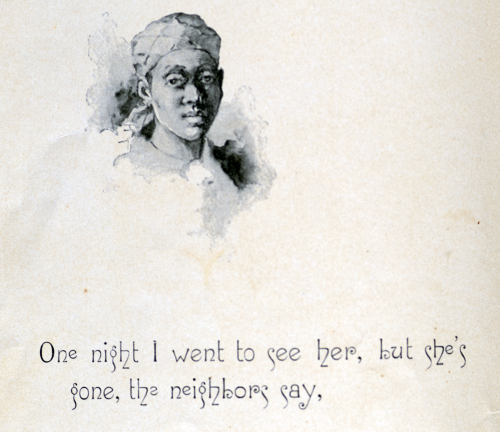
Benjamin Hanby’s father was involved in the Underground Railroad, a network aiming to secretly get slaves to freedom in Canada. One former slave passed through the Hanby household – a man named Joseph Selby. Selby told the story of his lost love (Nelly), and his desire to go to Canada to earn enough to buy her freedom.
1892 edition of Nelly Gray, illustrated by George Brenneman
Benjamin’s father went into action to try to raise money for Selby. But, sadly, the escaping slave soon died of pneumonia, without ever seeing his love again. Nelly’s fate is unknown.
In this song, the resurrection of Lazarus is not mentioned – just Jesus’ tears. The real triumph of Christ comes later in the song. But in this verse – and in many ways still today – Jesus is as often misunderstood as He is praised.
And yet, Jesus is present in the suffering. The King is there by the grave. And we wait for a better day.
The slave in Hanby’s song looks forward to something better too:
Oh! my darling Nelly Gray, up in heaven there they say, That they’ll never take you from me any more, I’m a-coming — coming — coming, as the angels clear the way Farewell to the old Kentucky shore.
Whatever the current circumstance, however long we must wait for perfect justice and peace, Jesus’ identity is the same, as the chorus always reminds us. There is no doubt that the better day is coming, because of who Jesus is.
’Tis the Lord! O wondrous story! ’Tis the Lord! the King of glory! At His feet we humbly fall, Crown Him! crown Him, Lord of all!
Dr. Schaeffer, as you may know, was a pastor and writer from the USA. In this particular book, he suggests four ways to evaluate art, whether it be dance, theatre, music or painting.
(1) Technical Excellence
I think we all know intuitively what he’s talking about here. Something done well, with technical excellence, is a great thing to see. It represents many hours of study or practice or rehearsal.
Do you see a man skillful in his work? He will stand before kings; he will not stand before obscure men.
Proverbs 22:29
Now, this doesn’t mean that we agree with the worldview behind the art. In fact, there may be technical excellence in something we would prefer not to see or listen to! But we can admit that it is well done.
For example, the original Star Wars movies present a very anti-Christian worldview. But they were done with excellence.
(2) Validity
Is the artist being true to himself or herself, and his or her worldview? Or, for example, is it obvious that this was created just to make a profit? I think there are a lot of movies today that are obviously geared toward making money and little else. And this doesn’t tend to lead to a lasting quality.
(3) Intellectual Content (Worldview)
Finally we come to the worldview behind the art. There is a worldview in architecture. There is a worldview in instrumental music. There is a worldview in the art that your government uses for their promotional materials. It may be that the artist isn’t even consciously aware of what is being communicated, or what this vision of the world is. But we all have one.
And, Dr. Schaeffer says, excellent art with an anti-Christian worldview can be terribly destructive in the culture. We need to judge it.
(4) Integration of Content and Vehicle
This is to say, you can have an ugly snake on a pole representing sin and suffering. You can have a majestic song to celebrate God’s glory. You may use different music, or different colours, for something sad or happy.
In other words, the form of the art should fit its message. You don’t want to create something that has a silly feel to it to talk about God’s judgement. A humourous cartoon mocking something who is suicidal would be offensive. There should be a harmony between medium and message.
Be sure to check out Dr. Schaeffer’s book – it’s not a long one: Art and the Bible
12 Keys to Good Music
For a number of years my father (Robert Cottrill) taught a course called “Music in the Christian Life”, a course which he developed. In the course, he listed 12 principles for evaluating music – but I think the same principles could be used in any kind of art. These principles are summarized on his blog; I encourage you to check them out as another way to think about how we evaluate art: Music Choice: 12 Keys to Good Music
I’ll leave you with those points to ponder. Next time, as we conclude this section on creativity and communication, we’ll have a few questions to ponder by way of application, and we’ll look at a fascinating story from Jesus’ earthly ministry.
My father was an expert on the history of hymns, having spent countless hours over many years researching and collecting resources. He published one book of hymn stories, and had manuscripts for two more.
I’ve been working through his articles and other materials, publishing them in blog format online. And at the beginning of this month (June) I started on the Hymn Almanac.
For every day of the year, he has facts and stories about hymns, often including a video or audio version of the hymn.
For example, yesterday featured the story of a hymn that was written when Elvina Hall’s mind began to wander during a sermon (shocking, I know). And have you ever wondered what in the world the “Balm of Gilead” is all about?
So for the next year, Lord willing, I’ll be publishing mostly posts from this almanac, every single day of the year (2022-2023). If you know someone who is interested in hymns, would you do me a favour? Would you send them the link – http://wordwisebiblestudies.com ?
I think you’ll find the information fascinating, and sometimes it will be information you won’t see anywhere else (for example, my father met more than one hymnwriter. And guess why he called up a circus museum one day to find out about one hymn writer, who had been a clown?).