How to Suppress the Truth (podcast)
Or, How to Fight the Lie.
This is one of the sermons that I preached while we were in Canada last year. It’s based on Romans 1:18.
Podcast: Play in new window | Download

Or, How to Fight the Lie.
This is one of the sermons that I preached while we were in Canada last year. It’s based on Romans 1:18.
Podcast: Play in new window | Download
Thanks for joining me for a deep look at another Christmas carol! Here’s the complete index for Angels from the Realms of Glory:
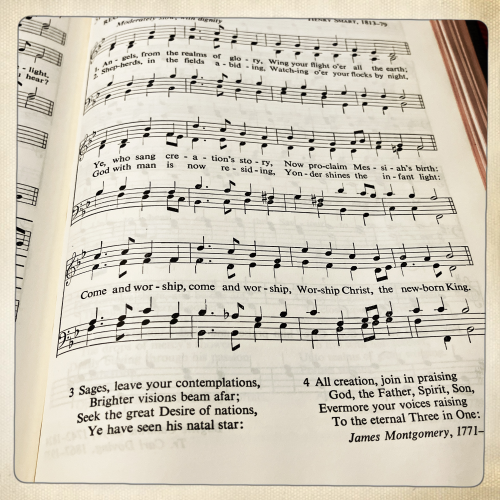
We started by singing about the creation of the world. The angels that marvelled at God’s creative work later call us to worship the Baby in the manger.
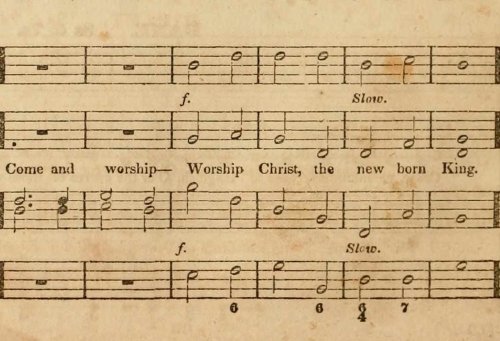
Finally, we saw the One through whom the world was made ruling the nations, unchallenged, in His Kingdom. Yet another reason to worship!
In 1986, Jack W. Hayford took the Christmas hymn and wrote new words – making it a Resurrection Sunday hymn (Worship Christ the Risen King):
Rise, O Church, and life your voices;
Christ has conquered death and hell.
Sing as all the earth rejoices;
Resurrection anthems swell.
Come and worship, come and worship;
Worship Christ the risen King!
Once we had a Christmas-Easter service at our church (something my Dad had done) halfway between the two dates – it would have been interesting to combine the two versions, or sing one at the beginning of the service and one at the end! Why not try it one Sunday in February?
But the final verse of Angels from the Realms of Glory, one not often sung, is pure praise:
All creation, join in praising
God, the Father, Spirit, Son,
Evermore your voices raising
To th’eternal Three in One.
Come and worship, come and worship,
Worship Christ, the newborn king.
Certainly a fitting ending to a song either about creation, incarnation, or resurrection!
The Baby in the manger was God incarnate, God the Son (Isaiah 9:6; Colossians 2:9). The Father sent Him (John 17:25), the Spirit brought Him into the world (Matthew 1:18), and He accomplished the salvation of His people as a man (Matthew 1:21). Three Persons, One God, bringing salvation to a lost world. A Triune act of love.
The missions-minded author, James Montgomery, gives us a carol that in fact leads us through the Great Commission to the fulfillment of all things in the eternal Kingdom.
And Jesus came and said to them, “All authority in heaven and on earth has been given to me. Go therefore and make disciples of all nations, baptizing them in the name of the Father and of the Son and of the Holy Spirit, teaching them to observe all that I have commanded you. And behold, I am with you always, to the end of the age.
Matthew 28:18-20
With all His disciples worldwide we wait for His return. And we do what the first disciples did, after they had watched Him ascend into Heaven: “While he blessed them, he parted from them and was carried up into heaven. And they worshiped him…“ (Luke 24:51 (emphasis mine)).
So as you sing or listen to this Christmas carol – may you do the same! Come and worship! Worship Christ, eternal King!
My grandfather was an organist, and even composed a hymn tune himself (called “Garside” after his church). Our Christmas carol got its most famous tune from another organist, published 42 years after the words were written.
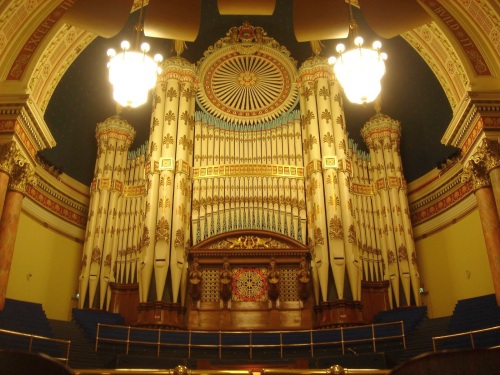
The man was Henry Thomas Smart, an organist from London. Not only an organist, Smart was a recognized expert on organs, designing several organs himself. (Incidentally, you can see one of the organs he designed in the Leeds Town Hall. It’s currently being restored, and you can even “adopt a pipe” if you want to help!) He was also a well-known composer, and like Thomas Cotterill he promoted the use of both Psalms and hymns by editing hymnals himself.
In 1864, at the age of 52, he went completely blind. But he continued his work, and it was three years later that he composed “Regent Square”, the best-known tune for Angels from the Realms of Glory.
Perhaps it’s appropriate that a blind man wrote the tune for a song that looks back to history and then forward in faith. The next verse of the carol puts it this way:
Though an infant now we view Him,
He shall fill His Father’s throne,
Gather all the nations to Him;
Every knee shall then bow down:
Come and worship, come and worship,
Worship Christ, the newborn king.
Looking back at the wonderful miracle of the incarnation of Christ, we must always keep in mind the future – as King of all people, He will one day be truly worshipped by all. Not only that, He will “gather all nations to Him”. Not only will some from all nations become believers, someday all nations will be directly under His rule, instead of the rebellion we see now (Psalm 2:1-3).
This should be a great comfort to us, as it was to those “coming out of the great tribulation” in Revelation 7:
…the Lamb in the midst of the throne will be their shepherd, and he will guide them to springs of living water, and God will wipe away every tear from their eyes.
Revelation 7:17
Philippians echoes the promise of God from Isaiah 45:22-24, proclaiming that Jesus Himself is Yahweh, to whom all will bow…
Therefore God has highly exalted him and bestowed on him the name that is above every name, so that at the name of Jesus every knee should bow, in heaven and on earth and under the earth, and every tongue confess that Jesus Christ is Lord, to the glory of God the Father.
Philippians 2:9-11
“Turn to me and be saved, all the ends of the earth!” says Yahweh in Isaiah. “Come and worship!” repeats our Christmas carol. Join those from every tribe and language and people and nation who will recognize the One born in Bethlehem as the One who is worthy of all honour and praise (Revelation 5:9).
Check out organist Craig Williams playing this rendition of Angels from the Realms of Glory on a pipe organ in New York.
Angels from the Realms of Glory links Old Testament promises with New Testament fulfillment, and even looks to the future.
This kind of explicit singing about Christ in the New Testament wasn’t very common when this carol was written. In fact, the singing of songs that were not Psalms was a matter of great controversy.
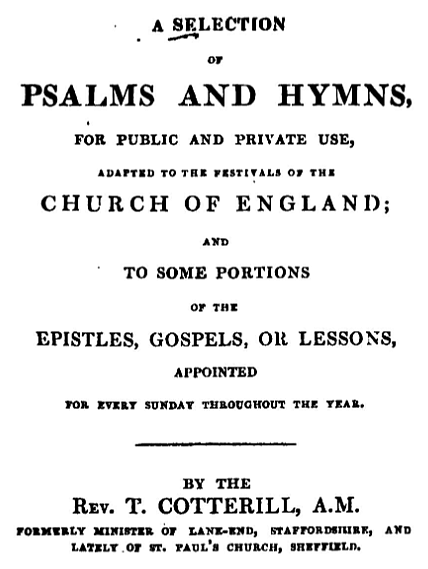
James Montgomery crossed paths with another songwriter who believed that both Psalms and newer hymns should be sung as a part of public worship, often making use of the New Testament revelation of Christ. Also in Sheffield for part of his life, the other man was Thomas Cotterill (quite possibly a relation of mine, but the specific connection is unknown. The general area of England is certainly right, but there were many Cottrills with all the variant spellings.)
Cotterill published some of Montgomery’s songs, and was editor of Selection of Psalms and Hymns, adapted to the Festivals of the Church of England. The songbook went through several editions, again, often amid great opposition. But in the end, this hymnbook would have a great influence on the many hymnbooks that were to come in the English-speaking world.
But back to our carol, which does blend the OT and the NT. The next verse is a bit ambiguous in the context of the carol, though very scriptural:
Saints, before the altar bending,
Watching long in hope and fear;
Suddenly the Lord, descending,
In His temple shall appear.
This verse seems to point to the future – or does it? The picture of the waiting saints is all throughout the Bible, of course – 1 Peter 1:10-11 is one example, speaking of the prophets of old that looked forward to Christ’s coming.
The Lord coming suddenly to His temple is a reference to Malachi 3 –
Behold, I send my messenger, and he will prepare the way before me. And the Lord whom you seek will suddenly come to his temple; and the messenger of the covenant in whom you delight, behold, he is coming, says the Lord of hosts.
Malachi 3:1
We immediately think of the messenger John the Baptist, and the first coming of Christ. In a sense, He did indeed suddenly come to His temple (suddenly in time, or unexpectedly). But while Jesus came in His first advent to save (John 3:17), the text in Malachi is looking forward to a time of judgement and condemnation of sinners. Sudden judgement is coming – and so now is the time for repentance.
Those who are waiting in faith will be rewarded. But there are still some who need to repent. This leads us to one of the most beautiful verses in the carol:
Sinners, wrung with true repentance,
Doomed for guilt to endless pains,
Justice now revokes the sentence,
Mercy calls you; break your chains.
Malachi warns those who think that they want the Lord to come: “But who can endure the day of his coming, and who can stand when he appears?” (Malachi 3:2a) When God comes in judgement, who will be declared innocent? Who will stand with confidence before the Lord? Surely no one.
And yet, with the sacrifice of Christ in the picture, it is actually “justice” that revokes the sentence. Through Christ, the sinner can justly be forgiven, because the price has been paid. Mercy calls you – break your chains! Of course, it is God alone who can set us free, but the poetic language calls the believers to find freedom and forgiveness in Christ. Now we can look forward to His coming with joy, instead of dread.
The Psalms certainly speak of the forgiveness and mercy of God, and of a coming Messiah. But looking back at Jesus’ first coming, we sing with triumph of an accomplished work.
Montgomery and Cotterill both believed that we could sing with confidence of the Saviour who had appeared on the earth, singing both Psalms and newer songs of the Church – all for one purpose – worship!
Come and worship, come and worship,
Worship Christ, the newborn king.
I mentioned that James Montgomery would be considered, by some, a bit of a rebel. The newspaper that he went to work for was the Sheffield Register (Sheffield – in England, east of Manchester). And that became a large part of his life.

The Register was a rare local newspaper that actually printed local news, rather than just reprinting news from London. But it was also known for some views that were radical, or at least reform-oriented. It promoted the abolition of slavery, and religious tolerance.
But politically it was a time of upheaval. The radical aspects of the French Revolution alarmed those in England who were afraid that the same violence would come to their shores. Calls for political reform were rightly or wrongly linked to political movements in France. As arrests began to take place, the editor of the Register fled to Germany.
Montgomery, having been with the paper only two years, took over along with another man, but eventually became the sole editor. He relaunched the paper as the Sheffield Iris, trying to distance it from its more radical roots.
But controversy still followed, and James found himself in prison more than once. The second time, he had written against a militia, who had responded violently to a public protest, resulting in two deaths.
But his Christian perspective came through as he meditated on the Christmas story. God had broken into the course of events of this world, and that changed everything.
Imagine the shepherds, going about their mundane business in the fields – the same as always. Until the angel made the announcement, they didn’t know that God was on earth. Yes, God is omnipresent, He is present everywhere in that sense. But imagine – God had come into time and space in the physical universe, as a baby…
Shepherds, in the field abiding,
Watching o’er your flocks by night,
God with us is now residing;
Yonder shines the infant light:
Come and worship, come and worship,
Worship Christ, the newborn king.
God has come – as an infant? Incredible! Incomprehensible! And yet true. A Baby, worthy of worship, because He is the Eternal King (Isaiah 9:6). Regular work will never be the same, now that God came to reside with us.
And then we enter the mystical academic halls of the magi. Philosophy, all the deep thoughts and knowledge of history, contemplated here. What could cause these men to leave the exclusive place of power and wisdom that they inhabited? (Colossians 2:8)
Sages, leave your contemplations,
Brighter visions beam afar;
Seek the great Desire of nations;
Ye have seen His natal star.
Come and worship, come and worship,
Worship Christ, the newborn king.
“Brighter visions” – again, a baby? Yes! And notice once again the worldwide impact of this event that Montgomery sees – Jesus is the Desire of Nations (for more on that term, check out this article). Paul said it this way:
For since, in the wisdom of God, the world did not know God through wisdom, it pleased God through the folly of what we preach to save those who believe. For Jews demand signs and Greeks seek wisdom, but we preach Christ crucified, a stumbling block to Jews and folly to Gentiles, but to those who are called, both Jews and Greeks, Christ the power of God and the wisdom of God.
1 Corinthians 1:21-24
There are many things that are important to us – maybe even actually truly important in our lives, our families, our communities. But there comes a time to realize that it is all meaningless unless we start with the Lord Himself, and His entrance into time and space, shown to the world first in Bethlehem.
In your daily mundane works, pause in wonder – God with us! In your important studies, arguments and discussions, take the time to leave them and realize that true wisdom was found by the light of the star, in a manger.
Pause, this Christmas. Pause, to come and worship. And there you will find the greatest Treasure of all.