I’m a little over 3 months late, but I did want to report on an evangelistic event that we had in Las Palmas, because it was a good time.
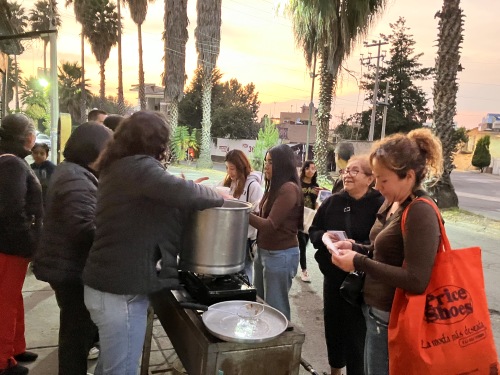
So one of our beloved Christmas traditions here in Mexico is ponche, a hot punch filled with fruits. So we set up a stove on the street in front our church meeting place, and served ponche to the passersby.
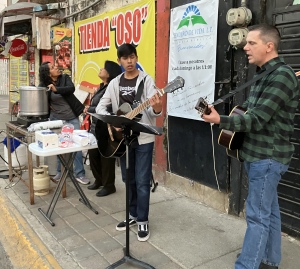
Some served the hot drinks, some shared the gospel, some walked around the neighbourhood to invite people to come, and some played Christmas carols.
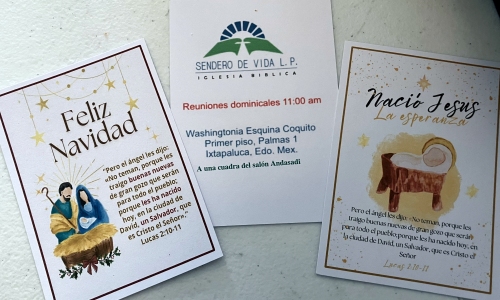
And we also handed out little bags with a candy or two, a verse, and information about the church.
Many people heard the gospel and received information about the church. About 200 of our little information cards were handed out, which means that many households in the community now know that we’re there.
You can see in the image above right that we have a sign at street level for the church, and we hope to put another one up above so people can clearly see where we are.
We appreciate your prayers as we continue to build on this start, or actually restart, since we’ve returned to Las Palmas after meeting elsewhere!
Thanks for joining us for our brief tour of the great Christmas carol, “What Child is This?”! Here’s an index of this year’s posts, as well as some additional resources to check out. And check out below for one more interesting note about a change that has been made in modern renditions of the song, and what the original is actually referring to.
I mentioned briefly the fact that some renditions of this song leave out the last two lines in verses 2-3. But another very common change is in verse two – changing the line “Where ox and ass are feeding” to “Where ox and lamb are feeding”.
Now, we all know why this change was made – modern audiences are uncomfortable with the word “ass”, and “donkey” just isn’t going to fit with the music. But.
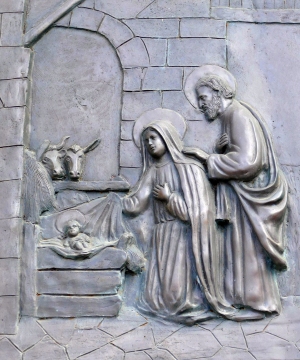
But you should probably know that there is a long, rich tradition that’s lost if you change the donkey to a lamb. Even look at the nativity scene picture I posted here. Yes, they threw in a lamb for the shepherds of Luke 2, but there they are, close together, in a modern day nativity scene – the donkey and the ox. Why?
Well, it was as early as the second or third century, or perhaps earlier, that people were making the connection. Through Isaiah, God lamented the unbelief of Israel:
An ox knows its owner, And a donkey its master’s manger, But Israel does not know; My people do not perceive.
Isaiah 1:3
Yes, even the ox and donkey know their owners – actually, their owner. Not only that, they recognize his manger!
Although the gospel writers mention no animals by Jesus’ manger (we can certainly imagine that they came for their dinner and were surprised at what they found!), it would certainly be appropriate if even the animals were there to worship their Owner, especially in light of this verse.
But there’s more. As believers reflected on this, they were reminded that all creation is under its Creator, and sometimes the creation seems to be more inclined to worship God than humans are (see Psalm 19:1; Luke 19:40; Romans 1:20).
Other carols mention this pair:
“Ox and ass before Him bow; and He is in the manger now.” (Good Christian Men, Rejoice)
“Ox and ass kept time” (Carol of the Drum (The Little Drummer Boy) – as originally written – hear the Trapp Family Singers sing it here)
“The ox and donkey, so they say, did keep His holy presence warm” (Burgundian Carol)
There’s even more to the tradition – another reason why these specific animals are important. Noting that the ox, under Jewish law, was a clean animal, and the donkey unclean, the two became associated with Jews and Gentiles. Hence, Jesus came for both Jews and Gentiles – for the whole world.
Of course, without all the speculation, the Bible itself tells us that – even in the Christmas story, where it’s likely (although a few have suggested otherwise) that the Magi were Gentiles, and shepherds of course Jews. Going on in the book of Matthew, even Jesus points out that many Gentiles would be in the kingdom (Matthew 8:11).
I certainly understand why the substitute is commonly made – but maybe before we quickly change traditions, we should at least think about where they came from and why they’re there, just as we should be hesitant to “move the ancient boundary” (Proverbs 22:28). No, we don’t raise tradition to the level of Scripture. But sometimes these traditions remind us of important truths.
So the next time you see the ox and donkey at a manger scene, remember – He is indeed the Owner of all creation. And He came to save not only His nation, but peoples from every nation!
In the first verse of What Child is This?, we learned that the Baby on Mary’s lap was actually Christ the King. Our response? To hurry to bring Him the praise He deserves.
In the second verse, we learned that this Messiah was coming to bring us salvation, through His suffering. So the author ends the verse with“Hail, hail the Word made flesh” – we acknowledge His purpose, His salvation.
But now we end with a complete change of attitude, resulting in action.
So bring Him incense, gold and myrrh, Come peasant, king to own Him;
Of course a reference to the three wise men, the magi, who worshipped Him and brought gifts (Matthew 2:1-12). As a matter of fact, everyone, rich or poor, should come to worship. To “own” – as in to confess, acknowledge. To speak and act according to the truth – He is the King of Kings.
The King of kings salvation brings, Let loving hearts enthrone Him.
As explained in verse 2, Jesus took on human flesh to save sinners (Matthew 1:21; Matthew 9:13). He is coming not to judge (this time – John 3:17), but to save. In thankfulness we serve Him as king, because He is King.
Raise, raise a song on high, The virgin sings her lullaby.
We bring our gifts and worship, we serve Him as king, and now we sing – as a testimony to all, we sing our Christmas carols!
And how can you not love the next line – “The virgin sings her lullaby”. At first, apparently, it was just a baby on his mother’s lap. Now we have a fuller understanding of the miraculous truth. He’s a miracle Baby, the promised Messiah, the King, the Saviour.
And it all starts with a mother singing to her newborn – but this is no ordinary newborn! What a contrast.
Joy, joy for Christ is born, The Babe, the son of Mary.
All this is because of a complete change in attitude. We didn’t even know who this Baby was – but now we do, and that brings us joy! It’s not any baby, it’s Mary’s Baby, the long promised Messiah…
But when the fullness of the time came, God sent forth His Son, born of a woman, born under the Law, so that He might redeem those who were under the Law, that we might receive the adoption as sons.
Galatians 4:4-5
The word “Christ” itself is really a summary of the entire Old Testament. The world, created good by God, cursed because of sin, was promised a Saviour. But the wait was long! As another carol says, “Long lay the world in sin and error pining…”
And finally, along came the Messiah, the Christ, the long-awaited and final sacrifice for sin. Sin now has an expiry date – it will be gone from the earth and heaven, and its curse will be gone, and we will truly enjoy life with the Creator forever.
And so we sing again, as we celebrate –
Raise, raise a song on high, The virgin sings her lullaby. Joy, joy for Christ is born, The Babe, the son of Mary.
Yes, this is the 8th year that I’ve done a series about some of the great Christmas carols, Christmas songs. Why break the tradition now?
This song, like many, has some unusual roots. In fact, we might have to ask if William Shakespeare would be shocked if he knew how this one turned out. At the end of the 1500s and dawning of the 1600s, he pointed out the irony of – well, we’ll get into that later.
This is a shorter song, but still one with some profound truth about the birth of the Saviour. A question is asked, then answered, with awe and worship. The incredible paradox of the incarnation of Jesus Christ.
Do you know which carol this is? Well, next time you’ll find out!
Who is He in Yonder Stall? is a song of contrasts. We have a Baby in an animal’s feeding trough. We have a Man in the wilderness, weeping.
Then we have a Man who is sought after and admired for His compassion and gracious words.
But then He prays in the garden, and dies an agonizing death. So undeserved! Who is He?
The chorus is, of course, the contrast. But in the final verse, what has been wrong is made right. The suffering Man is no longer suffering. The misunderstood no longer misunderstood. The One who loves and heals takes the position that He deserves and we desire.
And it all starts when the dead comes to life:
Who is He that from the grave Comes to heal and help and save? Who is He that from His throne Rules through all the world alone?
Some people have questioned whether or not the Baby really was “the Lord”, as the chorus says. After all, wasn’t He “exalted” after the cross (Philippians 2:5-11; Hebrews 1:1-4)?
Well, certainly, He took a new position as the gracious Saviour, the One who triumphed over death and ascended to the Father, later on. And we still await His complete unopposed rule on the earth.
But Hebrews 1 actually answers the question, by applying Psalm 102 to the Son. “You, Lord (Yahweh), in the beginning founded the earth, And the heavens are the works of Your hands” (Hebrews 1:10). He was already Lord at the dawn of time. He was Lord on the cross (1 Corinthians 2:7-8). He was Lord when He ascended, and He is Lord today.
And if anyone has any doubt, He will be seen as Lord in the future and forever.
What does it mean that He is Lord? It means that He was in charge and in control when there was no room in the Inn in Bethlehem. He was in charge and in control when He was murdered by sinful men on a cross. And He is still in charge and in control. Which means that history has meaning, and purpose. And the seemingly strange contrast of a gentle, suffering Man who is Lord will be seen as a further reflection of His eternal glory.
We don’t always see, today, the purpose in history. But God does share with us the great panorama of His grand plan. The author of Hebrews says it well:
…For in subjecting all things to him, He left nothing that is not subject to him. But now we do not yet see all things subjected to him. But we do see Him who was made for a little while lower than the angels—Jesus, because of the suffering of death crowned with glory and honor, so that by the grace of God He might taste death for everyone. For it was fitting for Him, for whom are all things, and through whom are all things, in bringing many sons to glory, to perfect the author of their salvation through sufferings.
Hebrews 2:8-10
Benjamin Hanby recognized that the important thing was the identity of this Man, His characteristics. Powerful and compassionate – and Lord of all! Let this song remind you of that this Christmas, and into the new year.
’Tis the Lord! O wondrous story! ’Tis the Lord! the King of glory! At His feet we humbly fall, Crown Him! crown Him, Lord of all!
Even those unfamiliar with the Authorized Version (King James) of the Bible might know this archaic word. After all, even today many people know the story of the angels and shepherds in Old English:
And there were in the same country shepherds abiding in the field, keeping watch over their flock by night. And, lo, the angel of the Lord came upon them, and the glory of the Lord shone round about them: and they were sore afraid.
Luke 2:8-9 (AV)
Lo! Another translation of the word has carried over into some modern translations, because it’s hard to find a more contemporary word that is as accurate – Behold!
“Lo!” may actually be a short form of “look!”. The idea is just that – “Look!” “Pay attention to this!” “Unbelievable, but true…”
The word appears often in the Christmas story. Here’s just a sample:
“And behold, you will conceive in your womb and bear a son, and you shall name Him Jesus.” (Luke 1:31)
“Behold, a virgin shall be with child, and shall bring forth a son, and they shall call his name Emmanuel, which being interpreted is, God with us.” (Matthew 1:23)
“But the angel said to them, ‘Do not be afraid; for behold, I bring you good news of great joy which will be for all the people…'” (Luke 2:10)
“Now after hearing the king, they went their way; and behold, the star, which they had seen in the east, was going on before them until it came and stood over the place where the Child was.” (Matthew 2:9)
But the word also appears at the end of the story. When the resurrection happens, of course. But before that, when Jesus is talking about the cross. The fact that He, the Lord, would be betrayed and bound and crucified was in many ways “unbelievable but true”.
And He came the third time, and said to them, “Are you still sleeping and resting? It is enough; the hour has come; behold, the Son of Man is being betrayed into the hands of sinners…”
Mark 14:41
Hanby has been writing about the humility of the Saviour, the compassion of the Saviour. But – wait! Look! Sorrow, and pain – so undeserved.
Lo! at midnight, who is He Prays in dark Gethsemane? Who is He on yonder tree Dies in grief and agony?
The first shock of the song was that Jesus was born in humble circumstances. The second shock is that He dies in grief.
Often in New Testament Greek the cross is referred to as the “tree”. Some English translations make this clear, but others do not. A tree was a place of testing in the Garden of Eden. The Tree of Life was taken away because of the curse. (Genesis 3) The tree became a place of curse (Deuteronomy 21:22-23). Jesus became a curse for us on a tree (Galatians 3:13). Because of His death on a tree, the Tree of Life is restored to us (Revelation 2:7).
Now the tree represents new life for us. But most did not understand at the time, when Jesus was hung up on the “tree”, that this was the great “Lo!” of history – the moment that all must look to – the cursing that brought blessing. The grief that brought eternal joy (Hebrews 12:2).
And His obedience in His death leads to eternal worship.
Worthy is the Lamb that was slain to receive power and riches and wisdom and strength and honor and glory and blessing.