Shari took this wonderful photo of a little visitor we’ve had in our yard lately. I told her that if she was going to talk to him, she would have to give him a name. I suggest Herbert.
That has nothing in particular to do with this post, except that you may be wondering why I haven’t been posting much. In a way, I suppose, it’s the usual excuse – an extra busy time, for a number of reasons!
Sometimes things move along quickly – more often progress seems slow. But God continues to work!
Recently I enjoyed teaching Sunday school. We’ve been doing some random themes in Sunday school – things that we think are needed, or things people ask for. This was one of the latter – a series of two classes on Bible translations.
I’ve taught the “Where did the Bible Come From?” seminar in this church, though it’s already been a few years. So I designed these classes as a bit of an extension on the teaching about Bible versions.
We laid some of the theological foundations in the first class. And then talked about some specifics in the second class. We talked specifically about how manuscripts are used to translate, and then issues of translation itself – translating at different levels, more literal or more of a paraphrase, and so on.
In Spanish, and in English too, actually, there have been more translations in recent years that are put out by certain sects that are less an attempt to be faithful to the original, and more of an attempt to fit a certain theology or certain ideology. Some of these have been around a long time, but there are others that are more recent. I think it’s more of an issue than it used to be when I first started teaching on this topic.
That was last Sunday – and actually, that will be our last adult Sunday school class for a while. We’re anxious to prioritize and put our energy into what’s most needed and most effective. So we’re going to be looking at some special training for certain groups in the church. We’ll see how that goes.
Although adult Sunday school is taking a haitus, children’s Sunday school is continuing! Shari is going to be involved a little more again with teaching the kids, which includes lessons and things like activities and verse memorization. They’re learning about the life of Jesus right now.
We ended our classes on Bible versions with this little text from Colossians, which reminds us of our responsibility when it comes to the Bible:
And let the peace of Christ rule in your hearts, to which indeed you were called in one body, and be thankful. Let the word of Christ dwell in you richly, with all wisdom teaching and admonishing one another with psalms and hymns and spiritual songs, singing with gratefulness in your hearts to God. And whatever you do in word or deed, do all in the name of the Lord Jesus, giving thanks to God the Father through Him.
In 1986, Jack W. Hayford took the Christmas hymn and wrote new words – making it a Resurrection Sunday hymn (Worship Christ the Risen King):
Rise, O Church, and life your voices; Christ has conquered death and hell. Sing as all the earth rejoices; Resurrection anthems swell. Come and worship, come and worship; Worship Christ the risen King!
Once we had a Christmas-Easter service at our church (something my Dad had done) halfway between the two dates – it would have been interesting to combine the two versions, or sing one at the beginning of the service and one at the end! Why not try it one Sunday in February?
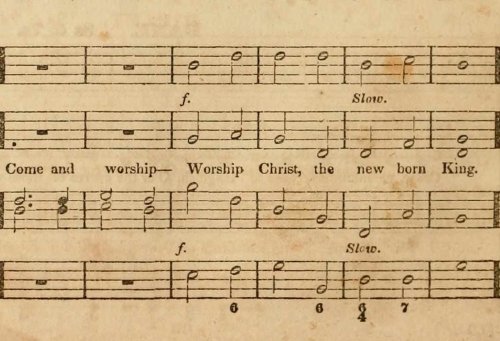
But the final verse of Angels from the Realms of Glory, one not often sung, is pure praise:
All creation, join in praising God, the Father, Spirit, Son, Evermore your voices raising To th’eternal Three in One. Come and worship, come and worship, Worship Christ, the newborn king.
Certainly a fitting ending to a song either about creation, incarnation, or resurrection!
The Baby in the manger was God incarnate, God the Son (Isaiah 9:6; Colossians 2:9). The Father sent Him (John 17:25), the Spirit brought Him into the world (Matthew 1:18), and He accomplished the salvation of His people as a man (Matthew 1:21). Three Persons, One God, bringing salvation to a lost world. A Triune act of love.
The missions-minded author, James Montgomery, gives us a carol that in fact leads us through the Great Commission to the fulfillment of all things in the eternal Kingdom.
And Jesus came and said to them, “All authority in heaven and on earth has been given to me. Go therefore and make disciples of all nations, baptizing them in the name of the Father and of the Son and of the Holy Spirit, teaching them to observe all that I have commanded you. And behold, I am with you always, to the end of the age.
Matthew 28:18-20
With all His disciples worldwide we wait for His return. And we do what the first disciples did, after they had watched Him ascend into Heaven: “While he blessed them, he parted from them and was carried up into heaven. And they worshiped him…“ (Luke 24:51 (emphasis mine)).
So as you sing or listen to this Christmas carol – may you do the same! Come and worship! Worship Christ, eternal King!
Truth, dependence, purpose. Three things that find their source in God. Without God and His Bible, in an imaginary world, there is no absolute truth, and honesty is not so important. We don’t depend on God, and so there is no salvation. And ultimately, no purpose. But again – that’s not the real world.
What was it that Paul said? “But thanks be to God, who gives us the victory through our Lord Jesus Christ” (1 Corinthians 15:57).
Let’s go back for a moment to personal responsibility – your own spiritual life. Do you really know Jesus Christ? No “know about” – really know. Do you talk to God? Read His Word? Love Him with all you are? We all fall short, but have you found perfect forgiveness and peace in God, putting your full faith and confidence in Jesus?
I’ve been promising for a long time to share the origin of the phrase “Christ or chaos”. It came from Peter Marshal, who was a pastor in the United States, and who became Chaplain of the United States Senate in the 1940s. He was preaching about the prophet Elijah, who called Israel to decide between Baal and Yahweh. Here’s what he said in part of his message:
Surely the time has come, because the hour is late, when we must decide. And the choice before us is plain — Yahweh or Baal. Christ or chaos. Conviction or compromise. Discipline or disintegration.
I have not stated the matter too strongly. You may agree mildly, or you may disagree violently. But the time has come for us to face the duties and obligations of our citizenship, and willingly to assume the disciplines imposed by the things we believe in, before we are forced to accept the disciplines of tyranny.
Why did the Romans hate the Christians? Why did they feed the Christians to the beasts? Not because they had yet another religion. There were many. Not because they had “received Christ into their hearts”. Why did the Romans hate the Christians? Because they said that Jesus Christ is Lord. Not the Lord of the church. Not the Lord of my spiritual life. Lord of all.
Lord of my body, every day of the week. Lord of my school. Lord of my country. Lord of the leader of my country. Lord of philosophy, Lord of science. Lord of creation. Lord of all.
That was something that Rome could not tolerate. Neither can our world today.
This is no game. We will suffer for this truth. But it remains true. And we serve the Eternal King who has all authority in heaven and on earth. I would prefer to follow Him, wouldn’t you? We may suffer, but this “affliction is preparing for us an eternal weight of glory beyond all comparison” (2 Corinthians 4:17)! We know who will be King forever.
Let’s finish with a text that we’ve looked at many times before – my prayer for you:
He has delivered us from the domain of darkness and transferred us to the kingdom of his beloved Son, in whom we have redemption, the forgiveness of sins. He is the image of the invisible God, the firstborn of all creation.For by him all things were created, in heaven and on earth, visible and invisible, whether thrones or dominions or rulers or authorities—all things were created through him and for him. And he is before all things, and in him all things hold together. And he is the head of the body, the church. He is the beginning, the firstborn from the dead, that in everything he might be preeminent. For in him all the fullness of God was pleased to dwell, and through him to reconcile to himself all things, whether on earth or in heaven, making peace by the blood of his cross. … Therefore, as you received Christ Jesus the Lord, so walk in him, rooted and built up in him and established in the faith, just as you were taught, abounding in thanksgiving. See to it that no one takes you captive by philosophy and empty deceit, according to human tradition, according to the elemental spirits of the world, and not according to Christ. For in him the whole fullness of deity dwells bodily, and you have been filled in him, who is the head of all rule and authority.
Colossians 1:13-20, 2:6-10
Amen!
Selected Resources…
I shared a few resources, either in the various articles, or at the end of each section. As I think I mentioned before, the list is probably more limited than it would be otherwise, because I was focusing on resources in Spanish, and not all of them are available in English.
For me, the next two studies that we did in our Biblical Anthropology series were the most challenging – Justice and Partiality. I have no idea how many articles and books I read while I was studying for this topic, which of course also touches on the issue of racism.
I think that one of the reasons why these topics were so challenging was that we do always see truth mixed with lies in our world. Sometimes we think that when someone is talking about love, or justice, or equality, that they’re talking about the same things that we’re talking about. But so often the world changes definitions, or else smuggles in something else with the truth.
As Christians, we know that God is just, and that justice comes from God and His Bible. For example, we protect the innocent before the law, even though this means that some people will temporarily escape justice. Temporarily, because we know that someday God will bring perfect justice to all. There is a final judgement.
We briefly introduced a few terms that have become important in our world, such as Marxism, or neo-Marxism, from the antichristian philosophies of Karl Marx.
“Marxism” doesn’t explain all the philosophy of the modern world, but we only had time to quickly look at some key points.
For example, in Marxism, you’re not judged by your character in the end, but more by the group which you belong to – as oppressed or oppressor.
And I should probably clarify something. If someone today says that a white man is racist, they’re probably not using a stereotype or a generalization. Under this philosophy, the individual white man is not considered racist because all white men tend to be racist, but because he belongs to the group, in this case a group defined by skin colour. Do you understand the difference?
Neo-Marxism is a revolutionary system. Everything must be burned down and rebuilt. Reboot, restart, rebuild better. So if you sometimes wonder why many people in power seem to be doing things that destroy more than build, often this is the reason.
But in biblical justice, we should be punished for our own sin. And there’s a lot of teaching in Ezekiel 18 about this. We are judged for our own character and actions. In God’s law, and so in the human court, we are innocent until proven guilty. And the source of your value is not the group you belong to, but the imago dei. And salvation is in Christ, not in activism.
We are all descendants of Adam, and so we don’t judge people (before the law) based on DNA, or skin colour, or whatever it may be. We judge, in a limited sense, in the way God judges – the fruit tells you what kind of a tree you have. We don’t judge in a different way because someone is rich or poor, because he has power, or has no home.
Another key point here is the unity of the local church. This from Colossians 3:11 – “Here there is not Greek and Jew, circumcised and uncircumcised, barbarian, Scythian, slave, free…” – and we could properly add, there is no man, woman, child, adult, Mexican, Canadian, rich, poor, whatever – “but Christ is all, and in all.” One Church.
Talking about justice in general, we believe that, in a sense, the law is king. The Latin term is lex rex. The prime minister, the scientist, the rich person, all are subject to the law. And the law must come ultimately from God’s Word. And so we could also say – veritas rex – truth is king. The truth, not the person in power, or the person with the scholarly title.
The famous Mexican revolutionary said, “I want to die being a slave to principles, not men.” Well, if those principles come from the Bible, from God’s Word, principles of justice, love, and compassion – then I would agree!
Truth is very important to the Christian. Honesty. Science. Logic. But the world rejects God’s truth to a large degree, and invents new “truths”, other “ways of knowing”. Standpoint epistemology.
The Christian accepts personal responsibility, and practises generosity and love. Many in the world today seem to want to give the government more and more control, so that they can be a saviour and a god. But where there is no absolute truth, when the law of God is rejected and limits are rejected, the lie with the most power behind it wins.
It is not the government that gives us truth, although it should defend the truth. The government does not give us rights, but it should defend the rights that are given to us by God.
That’s a lot to chew on for today. And I realize that some of these things have become even more a topic of discussion since we first did our study in Mexico. We need to keep thinking about these things and discussing them, with God’s Word as our foundation.
One of the first things that we learned in our Biblical Anthropology series was the concept of dependence. We were created as dependent beings – of course, the very fact that we were created means that we are in some way dependent.
And as human beings, we’re not only dependent on God, we also depend on one another, and on our environment in general.
And that’s why our next topic is “The Environment”. And it is, without a doubt, a very current topic. As was the case when I taught this series in Spanish, we are being inundated with news about the earth and climate change. When I first taught this series, the big news was COP26 – “the 26th UN Climate Change Conference of the Parties” – in Glasgow, Scotland.
But the truth is that most of us have grown up with environmentalism. Saving a species from extinction – climate change, pollution. It’s one of the great conversations of our generation.
And so we’re going to go to the Bible to study this issue. And as has been our custom, we’re going to start at the very beginning – Genesis 1. We started there at the beginning of our Biblical Anthropology series, and it feels like we’ve been hanging out there ever since!
In the beginning, God created the heavens and the earth.
Genesis 1:1
The source of everything – God Himself. And let’s remember what we learn in Colossians – “… by him [Christ, the Son] all things were created, in heaven and on earth, visible and invisible … in him all things hold together … in [him] are hidden all the treasures of wisdom and knowledge” (Colossians 1:16-17; Colossians 2:3).
Our Lord is the Creator and Sustainer of the universe. All wisdom and knowledge is found in Him.
God created all things, and so all things belong to Him. God never sold off His rights to the universe. He didn’t lose everything in a bad investment. All things are His.
The earth is the LORD’s and the fullness thereof, the world and those who dwell therein…
Psalm 24:1
Who has first given to me, that I should repay him? Whatever is under the whole heaven is mine.
Job 41:11
And so let’s begin with the basics:
God created all things.
God sustains all things. (Everything ultimately depends on God.)
God owns all things.
God is sovereign over His creation.
God gives all things their purpose.
Remember when God created the first man and woman, He gave them this command:
And God blessed them. And God said to them, “Be fruitful and multiply and fill the earth and subdue it, and have dominion over the fish of the sea and over the birds of the heavens and over every living thing that moves on the earth.”
Genesis 1:28
We’ve talked before about this as the “Creation Mandate” (in our discussion of technology). And in the same chapter, we read about the original state of Creation:
And God saw everything that he had made, and behold, it was very good. And there was evening and there was morning, the sixth day.
Genesis 1:31
Now, moving on to chapter 2:
The LORD God took the man and put him in the garden of Eden to work it and keep it.
Genesis 2:15
All of this is part of the purpose that God gave to the first humans.
Now, before we go any further… the environment has been a matter of massive debate in our lifetimes, and of course the Church has been involved in that conversation. At times, unbelievers have accused Christians of not caring for the environment, of not being concerned about the earth.
We don’t like to be called bad people, and we don’t want conflict. And so very often the response has been something like this:
“Just look at what the Bible says in Genesis 1 and 2. These verses show that we should be administrators of our earth as Christians. We are indeed responsible to care for the environment. And so – we’re all on the same side, right?”
And we take a giant leap from Genesis 1 and 2 into everything that we are being told to do.
In fact, believe it or not, there’s a “Green Bible”. Listen to this promotional material for this edition:
The Green Bible will equip and encourage people to see God’s vision for creation and help them engage in the work of healing and sustaining it. With over 1,000 references to the earth in the Bible, compared to 490 references to heaven and 530 references to love, the Bible carries a powerful message for the earth. This Green-Letter edition of the Bible will highlight scriptures in green ink that teach about God’s care for creation and how God interacts with creation, in an effort to bring greater awareness to how this message is woven throughout the Old and New Testaments. Essays from leading conservationists and theologians on how to read the Bible through a ‘green lens’ as well as a green topical index and Green Bible trail guide for personal study will be paired with teachings throughout the ages to show people how caring for God’s creation is not only a calling, but a lifestyle.
The Green Bible (2010)
First of all, for those who have studied hermeneutics (Bible interpretation), this line “With over 1,000 references to the earth in the Bible, compared to 490 references to heaven and 530 references to love” will be recognized as absolutely horrible logic – counting up references (verses?) about something, out of context, and using that to measure relative importance (now we know that the earth is more important than love?) – ridiculous. Just – don’t buy this Bible.
But anyway, we’ve seen this general strategy before. Take a phrase from the Bible, out of context, such as “love your neighbour”. Next, redefine the words, and use the phrase to promote whatever the world wants to promote. And this creates a “false consensus”. In other words, it looks like everyone is in agreement – on a very surface level – when that is really not the case.
I was at the gas station and someone came up to my window to show me their absolutely marvellous product. And sadly for them, I wasn’t interested. And so she said, “Don’t you like free gifts?”
“Not today, thanks.”
“Don’t you care about the environment?”
“Um… thanks….”
Now of course, if she really wanted to give me free gifts with which I could save the world, I guess I should have paid a lot more attention! But I have a feeling that there was a little more to it than that! 🙂
Yes, we have a lot of agreement with many who are not believers. Yes, as we’re going to see, we can work together – believers and unbelievers – to care for the planet. However, as we’ve seen throughout our study, very often our points of agreement are somewhat superficial. Look at the five absolutely basic fundamental truths that we have already looked at today – how many of these would an unbeliever accept?
And so we’re not going to simply appeal to Genesis 1 and 2 to include all the current ideas about climate change and conservation – we need to go a little deeper.
We’ve started with a look at the world in its perfect state, and God’s first commands. But we know that the world didn’t stay that way. So next time let’s look at the Bible’s teaching about the world after the Fall…
We know intuitively that art, in some way, can be used for “good” or “bad”. And it seems to us that there is “good art” and “bad art”. But of course many today would tell us that you simply cannot judge art, because it’s art! After all, artists should have absolute liberty to be creative.
Mr. Potter – we’ll talk about him later…
So today in our Biblical Anthropology series, we ask the question – can you judge or evaluate art? Or is it only a question of culture, or opinion?
Let’s go to a very important text in the book of Colossians. The Apostle Paul has been talking about Jesus Christ as the Creator and Sustainer of the universe. In Christ “are hidden all the treasures of wisdom and knowledge” (verse 3).
Now, he’s going after the false teachers, who want to bring back the feasts and dietary laws from Moses.
See to it that no one takes you captive by philosophy and empty deceit, according to human tradition, according to the elemental spirits of the world, and not according to Christ. For in him the whole fullness of deity dwells bodily, and you have been filled in him, who is the head of all rule and authority.
Colossians 2:8-10
“[Christ] is the head of all rule and authority”. Jesus said it this way in John 5:22 – “the Father … has given all judgement to the Son”.
Everything in all of creation is under the authority of Jesus Christ. Science, art, math, governments, churches, your workplace, your video games, your playlist. Everything.
We recognize that people have different preferences, and that’s fine. But everything is still under Christ’s authority.
We’re constantly creating art, our community is constantly creating art. And every movie, every band, every painting, every meme, must be placed under the authority of Christ.
This isn’t to say that every song should be a Christian hymn, and that every painting should represent a Bible story. But it does mean that all art must be for God’s glory. And even secular (non-religious) art can glorify the Lord. Even art created by unbelievers can glorify God, thanks to God’s grace in all the world, and the imago dei.
But let’s get real – very often the world is using art to actively fight against God. So we need to think about how that is done.
Let’s go back to where we started in our first study – Genesis 1 & 2. We looked at three keywords in that study – Truth, Dependence, and Purpose.
Yes, art does have a purpose. Even when it is supposedly simply “art for the sake of art”. Or when it’s deliberately “purposeless” art. But of course, that is its purpose. You simply can’t avoid purpose.
Dependence? We depend on something that is outside of ourselves, and all things depend on God. Or, we could say, they depend on Christ – “in him all things hold together” Colossians 1:17.
So let’s look again at what happened with “Nehushtan”, the bronze snake.
First, the people had to pretend that they didn’t depend on God. The image was controlled by unbelievers who used it as a false god. I mean, imagine if the image had been placed in a museum with a notice underneath: “Praise Yahweh for saving us from judgement – read the fourth Book of Moses for details”. Maybe the idolatry never would have happened!
The purpose of the bronze snake was changed. Instead of a reminder of God’s judgement, and a symbol of faith, it became a false god in itself.
And truth itself had to be ignored. “This isn’t just a metal image on a pole – it’s the mighty Nehushtan!” And perhaps the story of Numbers 21 was told, conveniently leaving out some important details, such as the sin of the people against God. Truth mixed with error. We’ve talked about that before – remember the house in ruins?
Finally, they separated the image and the Word of God completely. They tried to reinterpret the world, ignoring God’s revelation, God’s truth. “…men, who by their unrighteousness suppress the truth” Romans 1:18.
Claiming to be wise, they became fools, and exchanged the glory of the immortal God for images resembling mortal man and birds and animals and creeping things.
Romans 1:22-23
The world used its God-given creativity and ability to communicate to attempt to change the truth. Of course, you can’t change truth. But they hid it, suppressed it. How?
Have you ever noticed that when you see “popular sins” depicted on the big screen, there are rarely serious consequences? Immorality, for example, rarely results in disease and broken families.
And when you see a pastor or other Christian religious figure, usually they’re ignorant – or even evil? But if there’s an immoral person, that is, immoral in a culturally acceptable way, that person is often depicted as being very wise, or at least they’re the comic relief.
In Hollywood, especially in the 1930s-1950s, movies were regularly evaluated to determine if they were “decent”, and they were censored if they didn’t comply with certain criteria. For example, the 1946 movie “It’s a Wonderful Life”. One of my favourites, I’ll admit it.
If you don’t know the movie, it’s a fantasy about a man wanting to commit suicide, who is visited by an angel.
The movie almost had to be changed. Why? Well, in the story there’s a rich and evil man named Mr. Potter. Now, Potter is a wicked man, who is depicted as a wicked man in the movie. So far so good. Already we’re doing better than most of today’s movies.
But in this movie, he never experiences any significant consequences for his sin. There’s no punishment at the end. Of course, that’s the way things sometimes are in the real world – evil people seem to get away with their evil. But for some people, that made the movie “indecent”. My, how things have changed!
Today, it seems, movies must make evil look good.
Next time we’ll look at some current examples of how creativity and communication are being used by the world.