Last time in our Biblical Anthropology series we talked about the desire that many have to make everyone equal. Now, in certain sense, most people would agree that equality is a good thing. But there’s a lot more built into today’s common narrative.
One of the key things we’ve been talking about it that, in the minds of many, there must be a strong central authority to decide what “equality” involves, and then to take from some and give to others in order to enforce this “equality”.
Author A. D. Robles went through an interesting illustration once to demonstrate some problems with this idea. I won’t quote him exactly, but here’s the general idea as I shared it when I first taught this series.
Robles’ main point was that the supposed “mercy” of evil people often ends up being cruelty. How so?
Well, let’s take an imaginary country. In this country, people are at different economic levels. If you’re poor, survival is a challenge. Maybe you have a couple of jobs, just so that you can get by.
Now, let’s say that the imaginary government of the imaginary country decides to control the economy and help the poor people. Now, I don’t think this is the job of a government, but stay with me. They want to help the poor, so what do they do?
First, they give every poor person $1000. Great. Now, they double the minimum wage. Mercy to the poor, right? The most vulnerable.
Wait – here’s a good question to ask: Where did all this money come from? Well, maybe the government took it from the rich people, through taxes. We might call that theft, but they’re doing it for the poor, so we’ll give them a pass for the moment.
Now, what actually happens?
My friend Jake works down at the corner store. It actually belongs to his cousin – nice. His salary is doubled. Sweet! But now the store is having problems – it can’t really afford to pay Jake. Maybe he’s laid off. Or the store has to close.
No problem! There’s a big business down the street. Now, the big business doesn’t exactly have the same concern for Jake as his cousin did. But at least, for the moment, they can pay him the new minimum wage. And as salaries rise suddenly, many small businesses close, and larger companies take their place.
Their bottom line is money, of course. To pay more, they charge more. Prices rise to match the new typical salaries. But now some former small business owners no longer have their businesses. They’re looking for work – unemployment starts to rise.
With fewer people working, there are fewer products, or less variety available. The larger companies have less competition, and so they can afford to charge more.
Meanwhile, Jake is starting to have problems again. Not only are prices rising, he’s now helping to support his cousin.
So who is benefiting most from this “mercy to the poor”? The rich! Big business gets bigger. The rich, who knew how to prepare for inflation, ride out the storm, or even benefit from it. They knew how to invest. They get richer.
Meanwhile, unemployment rose among the poor, some are working in companies that don’t care about them, the $1000 was spent long ago, and if not it is already worth a lot less.
It looked like such a good idea at first. But government simply is not good at controlling all of culture. As we learned in our study of The Authorities, they have their responsibilities and their limits. And sometimes what seems good to us at first can end up as a disaster. The mercy of the wicked can be cruel.
So what’s the answer to a bad government? A new one with more control than the former one? That’s certainly the way we’re moving in our non-imaginary world. “We just need new and better laws! We just need more power to enforce these laws! And then we can finally help the poor children!”
But Jim, I don’t understand – aren’t we in favour of helping the poor? You bet. Absolutely.
So next time we’ll take a deep breath and get back to what the Bible actually says about justice for all.
When we went through the topic of partiality at our local church, we talked about an illustration that was common at the time – the “privilege walk”.
You may have seen this done – I’ve seen it done in a couple of countries, in English and in Spanish. But here’s the basic idea. Everyone starts off in a straight line. And then the facilitator calls out something like, “You grew up with a father in your home”, or “You have never wondered where your next meal is coming from”, and so on. Everyone who had this perceived privilege or advantage takes a step forward. Then there might be negative statements, like “My parents warned me before I left the house that I could encounter violence”. Take a step back.
In the end, you see that some people are far more “privileged” than others. And what generally happens is that the black woman is in the back, and the white man is in the front (in other words, the most “privileged”).
Now, I have some problems here, but let’s clarify something. Is there discrimination in this world based on the colour of your skin? Is there favouritism based on the country you’re from? Does life tend to be more difficult for someone who lives far from their family?
To all these we say – of course! And so there is no doubt there is something real and true, to say that some people have privileges or challenges, that other people don’t have.
But there are some things that are missing in these “privilege walks”. For example, there’s no personal responsibility. And that’s part of the point – you didn’t “merit” the privileges you have. But there is a danger of ignoring personal responsibility, personal choice (because remember, the ideology here is that personal “sin” or “merit” is deemphasized, and value based on your group is emphasized).
Another problem is that a few questions result in drastic oversimplification. Who decides which questions to ask? It’s easy to “design” such an activity so that a certain type of person ends up at the back of the pack. What’s more important? Being rich? Being powerful? Feeling safe? Living close to family? Living in the country? Again, those in power, the “experts”, decide.
What if someone is lazy? I suppose that the answer would be that everyone should start at the same place. But it becomes not important if the experts decide that you’re in the “oppressed group”. That lazy person should have the same resources as the hard worker. What if a person decides to stay home with the children, instead of being in the workforce? That’s a personal decision – should they be given some of the money of the worker? What if someone decides they would like to live in the country instead of the city?
We actually did a “privilege walk” at our church, but with some twists. First of all, we used completely invented countries and backgrounds to guarantee a certain level of diversity. Everyone received a card with their own invented biography.
Once we finished the activity, and saw who all the “privileged” people were, we had a few more questions. And it turned out that they weren’t so privileged after all.
The point was that the maker of the questions can manipulate where people end up, and that sometimes people with more money and more education are actually not as privileged as you may at first think. People with big houses may have massive debt. People in private schools may be mercilessly bullied. It’s complex – everyone has their own story. Slotting them into groups is not so easy.
Marxism, or neo-Marxism, wants everyone to end up with the same amount. And there are some serious problems with this. We’ve already mentioned one problem – it turns God Himself into an unjust “oppressor”.
Some people put it this way. It’s not about equality of opportunity – for example, the basketball tryouts are open to everyone. If they’re in the top few regarding skill, they’re on the team. No, it’s about equality of results. In other words, everyone gets on the team. Or, the experts choose not based on your basketball skills, but on your group. We need so many of each oppressed group on this team. That’s the idea behind what is familiarly called “social justice”.
Social justice, according to the world, has less to do with equality of opportunity, or equality before the law, and more to do with equality of results, according to the experts in control.
And it might sound great at first. But we’re going to end up with a terrible basketball team (worse, how about airplane designers?). We end up with people who don’t care about working hard, or gaining skills, because it’s simply not necessary. But what does the Bible say?
For even when we were with you, we would give you this command: If anyone is not willing to work, let him not eat. For we hear that some among you walk in idleness, not busy at work, but busybodies.
2 Thessalonians 3:10-11
We want equality, that sounds great. And we’ll talk about what the Bible teaches about equality. We don’t want to see anyone hated for the colour of their skin, or because of the country they come from. Agreed. But sometimes the solution that sounds good humanly speaking isn’t wise.
We’ll take a closer look at this concept in action, as an imaginary government tries to bring equity to their country.
There’s no doubt that one of the biggest concerns that the world seems to have right now is racism.
Well, it’s not just racism. There are a lot of words that are used today to identify the “oppressed”. Sexism (against women). Classism. Intellectualism. Sizeism. Or, sometimes we simply say “discrimination”. Discrimination based on age, discrimination against the disabled. And all the phobias, right? Homophobia. Cacomorphobia (that’s a fear of fat people). It’s an endless list. And there are huge problems with the way these terms are used, and with the terms themselves.
Now this may be a shocker for some people, but the term “racism” that is so popular today isn’t found in the Bible. The word “race” is mentioned, but how many times depends on the Bible version you’re using. Actually, in the Authorized (King James) Version, the only “race” is the kind you run in.
Usually in Scripture we have the idea of nations. In Greek, ethnos. We may say in English, ethnic groups. Ethnicity, of course, may include DNA, physical descendants. But it also includes the idea of structures, countries, cultures.
Culture is something that most fundamentally comes from family. You family does things in a certain way. You all talk like that. And then a group of families come together in a community, and that community is influenced to have a certain culture. And so on.
The Apostle Paul was making a speech in the city of Athens, at the Areopagus. During his discourse, he explains a biblical perspective of race and ethnicity:
The God who made the world and everything in it, being Lord of heaven and earth, does not live in temples made by man, nor is he served by human hands, as though he needed anything, since he himself gives to all mankind life and breath and everything. And he made from one man every nation of mankind to live on all the face of the earth, having determined allotted periods and the boundaries of their dwelling place, that they should seek God, and perhaps feel their way toward him and find him. Yet he is actually not far from each one of us…
Acts 17:24-27
“…he made from one man every nation of mankind…” – there’s that word, ethnos. Literally, in Greek, “he made from one” – that is, from Adam. In that sense, how many races are there in the world? One, of course.
We all come from God, as Creator. We are all descendants of Adam. We are all one family. And God, in His providence, decided where we would live, from what family we would come.
How strange and ridiculous to negate the value of another person in the family, someone else created by God. We are one race.
Of course, today, we commonly use the term “race” somewhat differently. We think about descendants of various groups/families. Or in DNA – physical characteristics, such as skin colour. (Note: this is a more traditional view of race, but new ideas have been introduced here too. Stay with me.)
Dr. Harold P. Freeman has studied this concept of race. He explains that the physical characteristics that we associate with race, differences in physical appearance, are from 0.01% of our DNA! In other words, 99.9% of our DNA has nothing to do with the stereotypical idea of race (see Are There Really Different Races?).
But we insist on a simplistic idea of race – stereotypes. Mexicans have a certain colour of skin, and they eat hot food (in reality, Mexicans come in many shades, and some actually prefer food that’s not so spicy hot). Chinese people are like this. Africans (let’s just have a simplistic view of a whole continent while we’re at it!) are like that. Race.
In 1859, Charles Darwin published a book which is another historical milestone for us. Do you know the title of his book, off the top of your head?
If you said, “On the Origin of Species”, I’m afraid you left out most of the original title, which was “On the Origin of Species by Means of Natural Selection, or the Preservation of Favoured Races in the Struggle for Life”. Read it carefully, and it will help you understand where Darwin was coming from.
You see, Darwin believed that some races were more evolved, more advanced, than others. In fact – and you’re going to love this – he believed that men had evolved with larger brains, meaning that they were more intelligent than women!
And the ideas of Darwin (and it’s not just Darwin, but remember, we’re trying to simplify) have been used to promote racism.
In contrast to Darwin’s ideas about various races, we know that there’s only one race, created by God. The human race. Every individual with value and dignity.
So what is the world’s solution to racism? Well, people have come up with various ideas throughout time, but let’s talk about the common narrative that we hear most often today.
You may remember our discussion of intersectionality. We all have various characteristics, various histories, that place us more in the “oppressed” group or the “oppressor” group. But remember, for them, individual sin is not so important, or may not exist at all.
Very often, according to the world, your value doesn’t come from God (imago dei), but from your group. And your sin isn’t something from your heart, it’s from your group (if it exists at all). In fact, because of your group, you may have no sin at all.
How does it feel to be profiled because of the group you supposedly belong to?
As we discussed before, many people believe that the problem is actually the system in which we find ourselves. That may be the “patriarchy” or the “hegemony”. And the problem with the system, they say, is that it gives certain privileges to some, and not to others.
Next time we’ll talk about one way in which this concept is illustrated, and why I have questions.
Who are we, as humans? We’re people who live in communities, in countries. People who desire justice.
I’m calling the next section of our study “Partiality”, and you’ll see why, but it’s basically a continuation of our study on justice. And in this section, we’ll be talking more about racism.
I imagine that most of us – maybe all of us – have experienced some kind of prejudice against us because of the colour of our skin, because of our faith, or because we’re not from “around here”, or because of our economic status.
The topic of equity or justice is very important – we could easily spend a year or two just on this topic. It’s important, and in a way very complex.
My hope, my goal, is that through this study we will see the incredible wisdom of God’s Word. But first, it’s important to understand more about the versions of “justice” that the world tries to sell us.
To start with, it may be helpful to clarify a couple of things.
In the first place, in this study we’re talking about many very current topics. And in taking on the topic of justice, or what the world thinks of as justice, remember that neither you nor I are experts. Why? Because the world is changing very quickly.
Now, of course, the truth of God’s Word never changes. And the majority of Satan’s lies are the same as always. But both are seen in different ways – or, we might say, applied in different ways – in different situations.
And so, on the one hand, we have a solid anchor in the Bible. Sometimes we notice that a child who simply believes what God says can see the lies better than an intelligent adult. “I have more understanding than all my teachers, for your testimonies are my meditation.” (Psalm 119:99)
At the same time, we all need to keep learning. Our enemy is clever and subtle. As Paul said, “we are not ignorant of his designs” (2 Corinthians 2:11). But yes, they are designs – schemes. Complicated.
Don’t forget about the house we talked about earlier! The lies always come mixed with truth. The lies are nothing – they’re not real. And so the enemy has constructed a house that is unstable, incomplete, in ruins. But from this, his headquarters, he still attacks.
In the last section we talked about Marxism. Marxism is an anti-christian philosophy that divides the world into two groups – the oppressed, and the oppressors. That’s the basis for the ideology of communism. And we’ll talk more about Marxism in this section.
But remember that every philosophy has its history, its roots. Marxism is only a part of the history of modern ideas of justice. It’s not the beginning of the story, nor is it the complete story. And so many who use ideas that are common in Marxism will deny that they’re Marxist, and may even claim that they are against Marxism. And if they’re in a Christian environment, they will use Christian terminology for their ideas.
Of course, some people admit their Marxist roots openly. As a recent example, the leaders of Black Lives Matter in the USA. They were listed by TIME Magazine as some of the most influential people in the world. One of the founders explained that they are trained Marxists. And also talked about invoking spirits – an involvement in the occult.
But there are indeed Christians making use of these ideas, who will deny any connection with Marxism. So why are we even bothering with this term?
Simply because it is a useful marker in history, a hook to hang our conversation on. Some may call modern ideas “neo-Marxism” – new Marxism. And from this come ideas such as liberation theology (so common in Latin America), social justice, critical race theory, and many related concepts.
Many believers have expressed concern about this stream of ideology for a while now. A well-known example, Pastor John MacArthur has said that the current ideas of social justice among Christians is the greatest danger to the church that he has seen in his lifetime. He, of course, is talking about the United States. But as many of you know, these ideas are all over the world, although sometimes they come in different forms.
And so what we’re doing here is taking very very complex ideas, and trying to simplify them into a manageable form. My hope is that we can take home some practical concepts that we can use in everyday life.
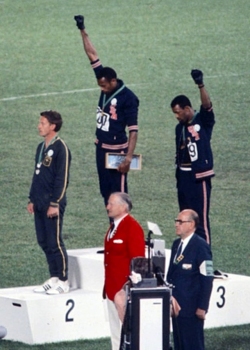
Often Marxist ideas are connected with a symbol – a symbol I’m sure you’ve seen: a raised fist. You see it everywhere if you take the time to look.
Mexico City 1968
This symbol was actually made famous in the Olympic Games in Mexico City in 1968, when two athletes from the USA raised their fists during the playing of their national anthem.
Now of course, no every time someone raises a fist is it related to some neo-Marxist ideology. But when you see the symbol, it’s not a bad idea to ask some questions.
Is there a division being made between oppressed and oppressor? Who is who? Are the ideas being promoted here biblical? Is someone asking a government or political party or other group to promote non-Christian ideas? Are these ideas promoting constant conflict and division? Is there a “revolution” being advocated here? (We’ve talked about many of these things earlier – be sure to read the series in order.)
And always remember – the lies will always be mixed with the truth. Remember the house.
And here’s another question to ask. What does this person or organization believe about sin?
Marxism advocates an idea known as the perfectibility of human nature. What’s that? The idea is that if we have proper systems in place, a properly organized society, if everyone had the same opportunities and resources, the world’s problems would disappear. The solution to the human problems is to improve the human environment – society, culture.
And so, what is said? Tell me if you’ve heard any of these phrases, or something similar. “This is for your safety, for your health.” “The poor children, suffering from racism, climate change, COVID-19…” “Look at all the disruptions in our world systems. We need to rebuild better.” All you must do is give us, the experts, the control. The problem isn’t the heart – it’s the social systems and institutions.
Ok, they may not exactly say that last part out loud. Or, they may.
As Christians, we know that this is not the solution. Why? Because humans are sinners. Don’t forget what Aleksandr Solzhenitsyn said (from an earlier post): “…the line dividing good and evil cuts through the heart of every human being.”
A human being can never be perfected, outside of a spiritual new birth. If there are unjust, unbiblical laws, we should be happy to fight against them. But evil will never be erased until the human heart changes. And so the final solution will never be a political party, a new law, a new system.
If our problem is that we don’t all have the same resources, that makes God Himself the evil oppressor. Listen:
Beware lest you say in your heart, ‘My power and the might of my hand have gotten me this wealth.’ You shall remember the LORD your God, for it is he who gives you power to get wealth, that he may confirm his covenant that he swore to your fathers, as it is this day.
Deuteronomy 8:17-18
Human perfectibility. For the neo-Marxists, we enter the world like a blank memory stick. And it is the culture, the government, and the systems that copy data onto that stick – good or evil, written onto our being. It’s not our fault – it’s the system. And that’s why we must burn it all down and create something new. That is the Marxist hope.
But as Christians, we know that we start life as sinners who need a Saviour – the Lord Jesus Christ.
And yet many people are attracted to this type of activism. Why? Because we all want justice! Right? We all want to do something. And we want to be seen as people who really are concerned about the oppressed – we want to be known as good people.
At the end of this section, we will try to get to some practical things that we can do. Because yes, action is very important. But we’ll leave it there for today, and get on to the topic of racism, etc., next time.
Everyone looks to some kind of “authority” for answers. The world these days often looks to anthropologists, sociologists, and other experts, especially in the area of justice. The Church, however, points to the Word of God, teaching and preaching in the power of the Spirit.
I hope to come to you soon, but I am writing these things to you so that, if I delay, you may know how one ought to behave in the household of God, which is the church of the living God, a pillar and buttress of the truth.
1 Timothy 3:14-15
Author Jon Harris has pointed out that the world’s new prophets are critical theorists, the new prophets are the media, the new clerics are the community organizers – the activists.
In the church, we celebrate Communion, remembering the completed work of Christ. But for the world, there is no “completed work”, no forgiveness. In the church, we celebrate baptism, meditating on the new life and future hope that we have in Christ. In the world, trust is placed in the experts, or the government. Or a future better government.
In the church, we work for justice according to God’s Word. And we start with the human heart. In the world, people seek power and control in order to enforce their version of justice, which in many cases is simply the freedom to sin against God. And it ends up being power in the hands of the few. It ends up being the “official narrative”.
Something to think about. What do you see when you look at the mainstream news? For example, how often do you hear about the thousands of abortions that happen each hour, and about the damage that they are causing to the bodies of so many women?
When I first shared this at our church, just over a year ago, I asked if anyone had heard the recent report from the InterSociety Nigeria, that in 200 days almost 3500 Christians had been brutally murdered in that one country? I don’t think anyone had heard about it, and yet in a just society, would it not be huge news?
No, we are usually only permitted to hear the official story, whatever that may be at the time.
As a local church, we must seek truth and justice. It’s not easy! But we can start with our own families. And our own communities. How can we help them?
As a local church, it is our job to share the truth of the gospel, because only transformed hearts can really transform a society. Because, as we’ve talked about before, it’s Christ or chaos.
The church and the Christian family can stand in opposition to the confusion and injustice of the world. But when we do stand against injustice, it will not be easy.
The world wants to divide us. “Burn it all down”. But the local church seeks to unite in Christ. And we’ll be talking about that more in a later post.
#7 – Eternal Justice
We believe that our future hope is not found in a future world, created by a powerful government, or by certain brilliant experts. We believe in perfect justice, brought by Jesus Christ.
What does God say about His Messiah?
Behold my servant, whom I uphold, my chosen, in whom my soul delights; I have put my Spirit upon him; he will bring forth justice to the nations.
Isaiah 42:1
From his mouth comes a sharp sword with which to strike down the nations, and he will rule them with a rod of iron. He will tread the winepress of the fury of the wrath of God the Almighty. On his robe and on his thigh he has a name written, King of kings and Lord of lords.
Revelation 19:15-16
Will guilty people escape the justice of this world? Yes. Will guilty people escape God’s justice? Never.
Remember the story that Jesus told, about the rich man and Lazarus? What did Abraham say to the rich man who was suffering in tormet? “Child, remember that you in your lifetime received your good things, and Lazarus in like manner bad things; but now he is comforted here, and you are in anguish.” (Luke 16:25)
And remember, without Christ, we are all guilty. We need His forgiveness. And when we have it, how wonderful it is! We don’t have to defend ourselves and pretend that we’re perfect just people in ourselves. But of course, as Christians, we do work towards a good reputation as people who are obedient to the Lord.
Next time we’re going to talk more about the topic of racism, which is of course a major justice topic of our day. And we’ll see how we can practise justice and promote justice in our world. Yes, we talk about many false perspectives. But our ultimate goal is to promote true justice, right? And we have a lot fo work to do.
It seems like we’re making slow progress on the topic of justice (part of our Biblical Anthropology series), but these issues are certainly important. So far we’ve looked at justice from three perspectives – truth, the imago dei (image of God), and the law. But let’s continue with #4 – salvation.
#4 – Salvation
What do I mean by “salvation”? Forgiveness of sin through our Lord Jesus. Freedom from those burdens of the past, so that we can live for the Lord with joy.
You will not find final forgiveness anywhere else.
Now, remember, the world is building on the foundations that God has given us, but their building a house of truth mixed with lies. And so you often hear these kinds of phrases from the world:
Love your neighbour
Social justice
equality and equity
security
helping the most vulnerable
rights
And when Christians hear these things, at least the majority of them, they say “Amen!”. These are Christian concepts. From the Bible.
But here’s the problem. Each one of these words and concepts is redefined by the world. And so when you don’t agree with the world, they shoot at you from their ruined headquarters. “You don’t love your neighbour!” “You’re against equality and equity!” But the world defines what these things mean, rejecting God’s own definitions.
Salvation, according to the world, must come through activism. And very often we look to a government to “save” us. Or we tear down a government and create a new one, a new “messiah”. Oops – that didn’t work. Let’s tear it down again.
And according to many, there is only salvation in continual redistribution and continual lamentation/repentance, – on and on it must go, because we can only find complete forgiveness and salvation in the finished work of Christ. Any other source must be continual works and never any peace.
#5 – Earthly Authorities
The world longs for justice. And we have the answer. We know how to apply justice, because we have God’s Word. And as Christians, we know that someday God will bring perfect justice.
But if you reject God, you need perfect justice now.
Let’s look at it this way. Do you remember the law about witnesses in the Bible?
A single witness shall not suffice against a person for any crime or for any wrong in connection with any offense that he has committed. Only on the evidence of two witnesses or of three witnesses shall a charge be established.
Deuteronomy 19:15
Think about this for a moment. Are there always 2-3 witnesses to every crime? Of course not. And so, if the government obeys God’s law, some criminals will escape.
“It’s not fair!” Fine, but we know that all will be judged by God, the perfect Judge with perfect justice.
So what is God doing, giving us this law? Why even bother with justice in this life?
God is giving us partial justice and order in the world, while protecting the innocent.
If there is reasonable doubt – we don’t condemn!
But the world wants complete justice – now. Now, because the world has rejected God. And so the end justifies the means. And so we shame people on social media, if someone seems guilty to us. And so we create so-called “hate laws”, because we believe that we must judge how people think (as if we know). We must judge the motivations of the heart.
Without the final justice of God, we ourselves must find a way to judge hearts and minds, not just actions.
The world must find a way to perfectly understand history, and correct all the injustices of all times – and correct them now.
But no one can take God’s place. There are – there must be – limits to earthly justice.
The Bible warns us:
You shall do no injustice in court. You shall not be partial to the poor or defer to the great, but in righteousness shall you judge your neighbor.
Leviticus 19:15
But the world says no – the government must take (steal) from the rich, and give to the poor, because everyone must be equal in every way. And yes, the government can steal using taxes. And yes, stealing from the rich is still stealing.
“You shall not be partial to the poor or defer to the great…”
We know that earthly justice has its limits. But we also know that God will bring perfect justice.
It is wrong for a rich person to steal. It is wrong for a poor person to steal. How do we know? We have God’s law.
But God also tells us to defend the oppressed, and we’ll talk about that more later. The law must apply to everyone, but injustice tends to attack certain people, right? The “vulnerable”, orphans, and so on. And so we do have work to do to especially protect certain people. Why? In order to make sure that the law is being equally applied to all, because in many cases it is not.
Recently I had reason to learn a little more about the legal system in Canada, a system that still retains many Christian values (in spite of its many problems). A lot of things in Canada’s legal system are set up so that everyone can have access – even the person who is not well-spoken, even the person without connections, even the person without resources. Why? Because the law should apply equally to all, and should favour neither rich or poor.
Two more “perspectives on justice” to go! See you next time.