
Mexico
Mostly about April travels
This past Saturday we went to Puebla. Puebla is a huge city, very unlike either Cuernavaca or Mexico City. For one thing, they have a lot of very wide streets. That sounds great, except that the streets usually have no visible lanes (unless you squint), which means that the actual number of lanes will vary from lots of very skinny ones to… well, one car swerving all over the place.
We had a long-overdue visit with some Canadian friends of ours, the Chapples. Somehow it’s nice to stay in a house where there’s a toy snowmobile lying around. (Note: sometimes I explain people’s nationality by their passport, sometimes by where they grew up, sometimes where they live … often those are all different things! And probably are in this case.)
The Chapples were very hospitable and we heard a little about what’s going on in Puebla, and the work they’ve been involved in in various parts of Mexico (Bible training is a big part of that right now). We also got to know their kids, who are bigger than they were (actually, the youngest one was completely new to us!).
On Sunday morning we had an interesting experience attending an "International Church" – in this case, the service was in English and Spanish. It’s strange hearing a sermon in English, but it was translated so we caught most of it. 😉 Actually, the pastor was from southern Ontario.
Then we went and hung out with Americans, Mexicans, Costa Ricans, and so on, at the farewell party for our field director and his wife, Jim and Cheryl Eberline. Jim and Cheryl have been such an encouragement and help in the little time we’ve known them – they will be missed (and after the party they know it for sure)! They’re heading to Uruguay in a few months’ time.
We cam home yesterday.
Tomorrow, I’m going to be going to Ixtapaluca (one of two possible places we may be moving to, the other being Texcoco) to hang out with the Fry family to see what’s going on there. We’ll be working with the Frys if we’re in that area. Lord willing we’ll be able to get our families together again soon, and soon after we’ll be deciding where we’re moving to. It’s always great to see the Frys!
On Saturday we’re going into Mexico City to see our friends Antoñio and Becky, and their daughter. We might even sing at their worship service on Sunday. (The new song? Mmmmm… let’s not rush that one!) We don’t get together with their family enough, but we’re students and he’s a pastor… not exactly multitudes of free time.
There are lots of other non-travel related things going on. I haven’t told you about the costumes we’re supposed to come up with for Hannah and Nathanael’s school for Mother’s Day (May 10)… that is a good part time job in itself. And the school explained the last detail of what they’re supposed to wear – all we have to do is actually make the costumes (or have someone make them?)!
That’s just a glimpse into what’s going on this month. The main thing is – we keep studying, and talking, and listening, and reading, and writing, and hoping that soon our Spanish will be good enough for the school and our leaders so that we can actually get ready to move. How do you say move in Spanish again?
Flintstone Vitamins
Did you have Flintstone vitamins when you were a child? I did. They’re still around, of course.
In Mexico, the Flintstones are still in reruns and are known as Los Picapiedra, starring Pedro and Vilma (Fred and Wilma). Not too long ago, Shari bought some Flintstone vitamins for Hannah and Nathanael.
 Pictured: Non-spicy Flintstone Vitamins |
Now, let’s back up a little. Nathanael and Hannah have a tendency to call anything with a strong flavour "pica". Pica or picante means spicy-hot.
Now our kids sometimes eat things that are spicy-hot, and sometimes don’t. Depends on their mood, I guess. But they also sometimes don’t like to eat things that simply have a strong flavour. Lately Nathanael seems more sensitive to things like that – not sure why.
So, back to the Flintstones. These were new vitamins for them, and they complained that they were pica. No, we told them, they’re not "pica". Eventually we found Nathanael just wouldn’t eat them, but Hannah did, so they got all used up except one.
By mistake Shari had bought vitamins that were supposed to be taken in 2s (it was a mistake because these are quite a bit more expensive). So with only 1 vitamin left, I volunteered to eat it so that they could move on to the new vitamins that are taken in 1s.
You guessed it. They really were spicy hot. Not just a little, either. It was pretty obvious.
That’s Mexico for you – pica tacos, pica candy, pica chewing gum… and pica children’s chewable vitamins.
Maybe I should start taking Flintstone vitamins again…
Snake on a stick
This whole story just drives me crazy. It all started not long after Israel’s victory against the King of Arad, under the leadership of Moses.
Things were going well, but what followed was a long journey, and the people got discouraged. And they started to complain to God and Moses. There’s not enough water. There’s not enough food. And this food you’ve given us? The "manna"? We just don’t like it.
This wasn’t the first time the people had spoken out against their Deliverer, and it wouldn’t be the last. But this time God sent them a powerful illustration.
Poisonous snakes began to slither through the camp. Many who were bitten died. The people who had been recipients of God’s favour discovered that they had placed themselves against God, and they came to Moses admitting that they had done wrong. They begged Moses to pray for them.
He did. And God answered with another illustration. Moses was to make a poisonous snake on a pole. If anyone was bitten, they were just to look at the snake on the pole, and they wouldn’t die. (read more in Num 21)
Jesus was to take up the illustration centuries later in His discussion with Nicodemus. Just as Moses lifted up this snake on a stick, Jesus would be lifted up, so that those who believed in Him would live (John 3:10-17). It’s a powerful symbol of faith and spiritual healing.
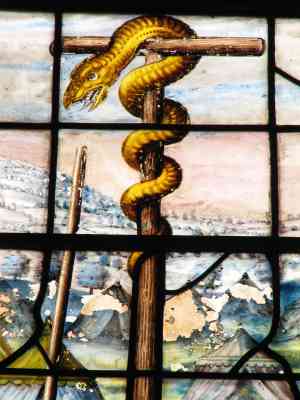 The bronze serpent by artists Bernard or Abraham van Linge on a window in the Lincoln College Chapel at Oxford. Photo courtesy of Lawrence OP |
We don’t know how long the snakes inflicted the camp of Israel, or how long the bronze snake was used for healing purposes. But along with other remembrances of what God had done, it was kept. You may remember that several items were kept in the Ark of the Covenant itself (Aaron’s rod, the 10 commandments and a bowl of manna).
The snake on a pole would have been a wonderful reminder of the dangers of opposing God, and complaining. It would also have been a reminder of God’s forgiveness, and provision for the healing of the people.
But now comes the part that drives me crazy.
Almost 1,000 years later we meet King Hezekiah, of Judah. He ascended to the throne at the age of 25, and proceeded to clean up the terrible idol worship that had taken over much of the nation. He tore down shrines and idols. And this is where we meet the bronze serpent again.
Apparently, the snake-on-a-stick had become an idol itself. The people worshipped it like a god, burning incense to it. No longer was it a reminder of God Himself, it had replaced Him. So Hezekiah destroyed it. (read 2Kings 18:1-4)
That drives me crazy.
It’s so typical, and so annoying.
One thing that struck me as I read again through the Pentetuech recently was that God knew the people needed physical illustrations and reminders. Woven into life were parties and traditions that taught the people what God is like. The tabernacle and temple were incredible teaching tools, and, as we know now, prophetic of Jesus himself, as the bronze serpent was. People needed these traditions and practices – but soon people made them meaningless hypocracies, or added meaning they were never intended to have.
It’s an often complaint against religion here in Mexico – that lines are blurred between the image and the real. Between honour (of saints) and worship. Between symbolism and a mystical means to gain God’s favour. And so, often when people have an encounter with the living God, they turn from the empty traditions that they once thought would save them.
One expatriate in Mexico was disappointed to find the church he attended did very little in the way of special celebration on Resurrection Sunday – perhaps as a reaction against the empty traditions they saw around them.
And it’s not one church or organization that’s at fault. It seems it happens to all of us – to all groups – to varying degrees. We start to worship the Bible itself as God. Or a "church building". We get more interested in the form than we are in the meaning.
Or we forget the meaning altogether, thinking that "going to church" will somehow "do us good", for example.
I love symbolism, art, music, drama, illustrations, stories… these things are a part of who we are, and are meant to glorify God. Admittedly, there are great dangers to tradition. After all, Jesus Himself spoke loudly against the empty traditions of His day, and how the religious leaders even used their interpretations of the law to twist the law of God itself (Mark 7:6-13).
Then again, Jesus gave us new physical reminders – the Lord’s supper, as we call it, and baptism. And believers have traditionally used other physical traditions – washing of feet to teach about servanthood, meeting on the first day of the week to celebrate the resurrection – and many more.
(I’m not addressing whether these things are "just" symbols, or if they hold a deeper reality – that’s another discussion! The point is that they are physical things in space and time that are related to spiritual realities.)
I guess what I’m suggesting is that we need to use these physical acts with care – maybe rejecting some that have come to have unbiblical meanings, maybe re-learning what the Bible teaches about some, maybe changing how they’re done, or examining them. But somehow there needs to be a place in the lives of the community of Jesus followers for rich, creative traditions. Those constant daily, weekly, and yearly reminders of God and His Word. But how can we do it without turning it into another snake-on-a-stick?
The US/Mexico wall
There’s been a lot of talk here about the fence that was built between the USA and Mexico. Here’s a quick view of a part of the wall, courtesy of the Washington Post.
Send me mail!
 |
Just kidding, you don’t have to. But if you want – well, you can. Mail isn’t always reliable here (meaning we may get it or we may not), but we’ve gotten all of the letters we know of that were sent. Packages too, come to think of it.
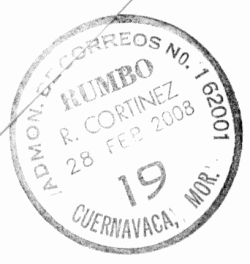
And this was a record. This letter was mailed on the 20th of February from small town Saskatchewan, and was stamped in Cuernavaca 8 days later! We got it shortly after that (don’t know exactly when, because we were away).
Of course, once it was six days between the time it was stamped at the Cuernavaca post office and the time we actually got it. That’s right, 6 days for a 20 minute drive up the hill. Weird.