One thing that continues to come to mind as I write and learn about culture here in Mexico is how little I actually know and understand. There is so much to learn, it boggles the mind. I’ve tried to seek to learn and not jump to conclusions. Listening and asking questions – that’s my job these days.
Check these photos and posts out – you can leave comments either place. I’d be interested to hear your thoughts.
We learned a lot this year about some things that go on during Holy Week here in Mexico. Here are a few more pictures from the TV coverage here in Mexico.
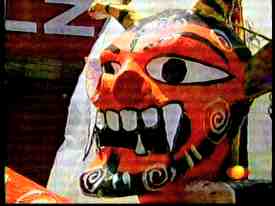
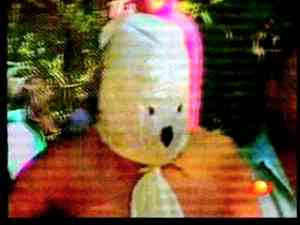
Take for example these guys. These were for sale all over Mexico – paper maché figures that represent Judas Iscariot (but look generally like devils. In a tradition that is familiar to many other countries as well, the figures are purchased on Good Friday and then BLOWN UP the next day (or Sunday). Kaboom.
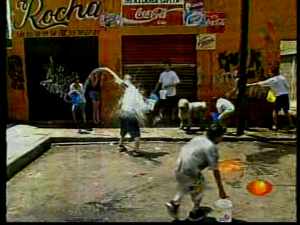
Another tradition is the Saturday morning water fight. I think back in the day it had something to do with purification, but generally now it’s just a lot of water and no rules. Ironically enough, not knowing about this tradition, I staged a little water fight in our yard for Hannah and Nathanael. Funny considering my previous experience on March 21st. Do I have a 6th sense for these things, or what?
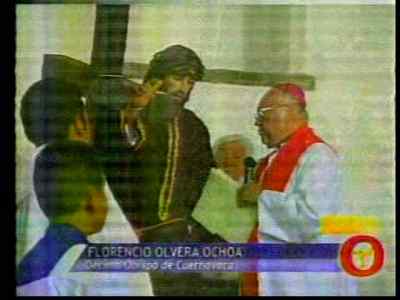
Of course there’s a lot of ritual in the Roman Catholic Churches.
Bishop of Cuernavaca and the figure of Jesus with the cross
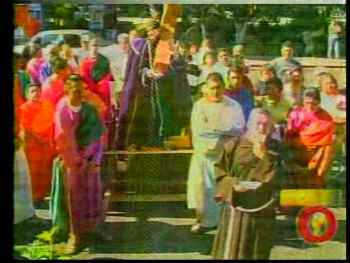
A procession carries the figure of Jesus through the streets of Cuernavaca
In Mexico, what is often called Easter weekend is a time for penance. People will put themselves through some pretty uncomfortable things in order to try to have sins forgiven, to gain favour with God, to help pay for the sin of those who have gone before, or to gain miracles for themselves or their community. This sometimes involves things like processions, crawling on your knees to the church, or walking barefoot on the cobblestone streets. It’s often a public affair, but in some cases faces are covered.
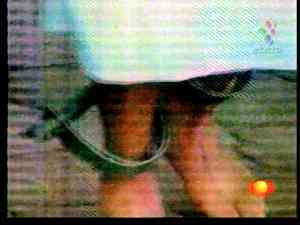
A hooded man going through a ritual. As you can see in the photo below, he is chained and goes barefoot.
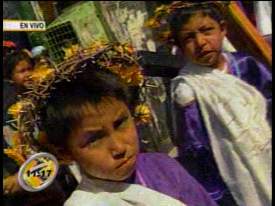
Children prepare for a procession
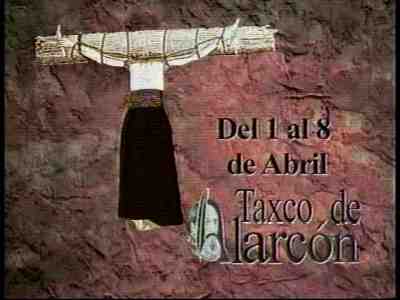
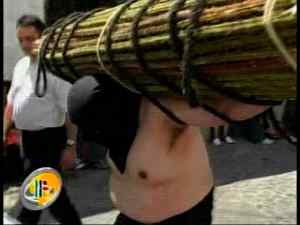
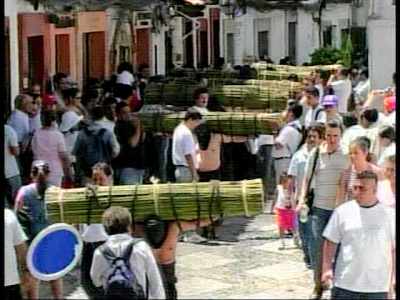
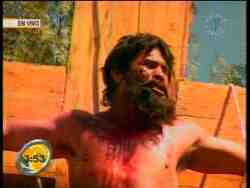
The last few photos are a little more disturbing. These next photos are, I believe, from Taxco. In the TV logo below you can see what you’ll see in the following photos in real life.
One of the more unusual forms of penance in Taxco involves carrying heavy stalks covered in thorns through the streets. Done after a lot of preparation and the support of friends and family, these men walk in agony through the streets trying to purify themselves and their communities of sin. The following two photos show the real thing.
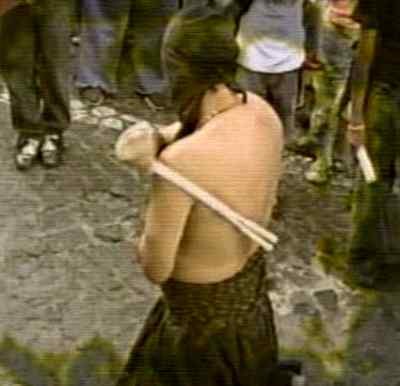
More common throughout the world is the practice of whipping yourself ritually. I purposely chose a "bloodless" picture, but normally after some time of whipping there are two large bloody patches on each person’s back. The whipping alternates from side to side, and like the ritual above is incredibly painful. I won’t say any more.
This all brings us back to the question – what is the cross of Christ really about? What did His death and resurrection accomplish? Many people today still don’t understand what it’s all about. Some of those people are incredibly devoted, others ignore it all together. And yet there are few (if any) questions more important. Please pray for Mexico.
I’m going to do two photo journals on some of the events around Holy Week (Easter) here in Mexico. I’m posting some shots of the TV coverage (this was going to be a video blog, but due to technical difficulties we’re sticking with the stills).
All over Mexico, every year, there are passion plays – depictions of His crucifixion and resurrection, and the time leading up to them. Some of these are small local affairs, but some, such as those in Taxco and Iztapalapa (near Mexico City) are massive events. Over a million (perhaps over 2 million) people come to Iztapalapa each year for this.
The events are acted in sequence in real time, including the last supper on Thursday. But Friday is the biggest show – the crucifixion. This is the biggest Good Friday event of its kind in the world.
TV coverage of the event
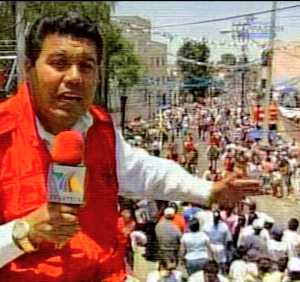
An announcer along the route where "Jesus" will pass carrying the cross
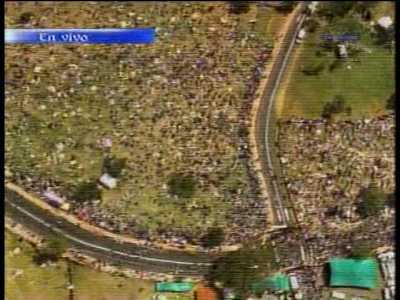
The crowds and cast members assemble. This is an aerial view – those dots are people. 😉
The entire community is involved in the production. There are costumes, horses, the whole bit. I should add that not everything here is entirely "fake". The actor cast as Jesus must have serious physical stamina to endure beatings, a very heavy cross and significant time on the cross.
Many people actually ask the actor portraying Jesus for a miracle. Though they realize he is an actor, they believe God will answer them because of their devotion. In the same way, many of the several hundred actors are looking for miracles, or believe they have been directed by God to be a part of the play.
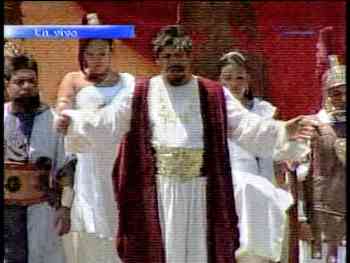
Pontius Pilot speaks to the crowd
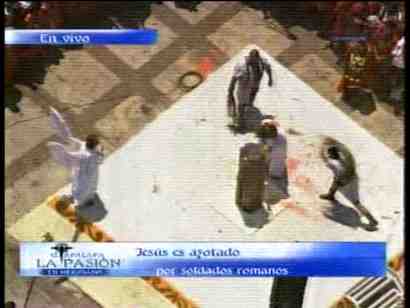
Aerial shot of "Jesus" being beaten by the Roman soldiers. Notice the angel on the left.
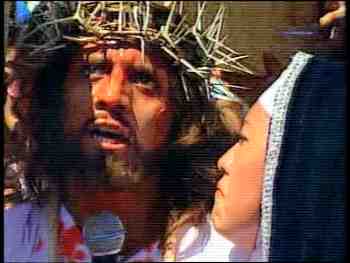
"Jesus" on the way to Gologtha, and I think the woman represents his mother Mary. She’s holding his mic.
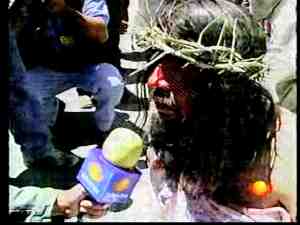
With all these realistic props, it’s quite a shock to all of a sudden see Jesus being interviewed by a reporter!
This is not just about the passion of Jesus. There’s quite a party atmosphere nearby – balloons, food, beer, and secular music. Quite a contrast to the somber scenes being portrayed!
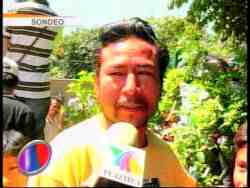
Throughout the day, they interviewed a lot of people who were visiting Iztapalapa or Taxco or wherever. Of course I could only understand so much, but there were quite a range of responses to the event.
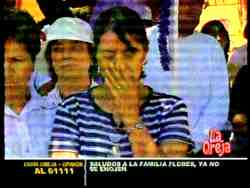
Woman meditates on the event. Some people really took the time to consider Jesus’ suffering, though how many really understand what it means is another question. Many commented that this was an important "cultural" event for Mexico and the Roman Catholic Church.
Other people said that they just came as a family tradition, or that they simply enjoyed the time with friends.
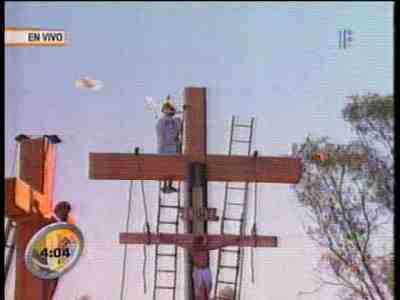
A thief on one of the crosses
At the moment of death, and angel above the cross releases a dove.
Read more about the Iztapalapa passion play here. In the next photo journal, I’ll write a little more about other Mexican traditions during Holy Week.
Last night at about 12:42am our time there was an earthquake about 60km (35mi) NNW of Acapulco. It was felt as far as in Mexico City, and beyond, and it was felt in Cuernavaca as well.
There were no deaths and only a few broken windows, as far as I know. The power went out in places like Acapulco and parts of Mexico City, though our power didn’t go out (though it has been out more than usual today). The quake was a 6.0 on the Richter scale. There have apparently been a few minor aftershocks.
There was some panic in various areas – people who have lived through more serious quakes know enough to take it seriously. No injuries or anything, but some evacuations, and spontaneous gatherings in central squares.
I know it’s not exactly earth shaking news, but … er, I mean … well, you know what I mean. But I thought some of you might have heard about it in the news, so I wanted to give you the on-site report. 😉
Our friends in Mexico City felt the quake and blogged about it here. Shari just got home and said her tutor felt it in the night too.
One more interesting note. This is yet another example of the current speed of news on the internet. People were finding out about the quake on Twitter instantly, and this blogger had a post up on his blog within 3 minutes (if I’m reading his comments right). Sorry, I guess I’m a slow blogger. 😉
This year in one of my classes on culture, I learned something that I’ll bet not too many people know.
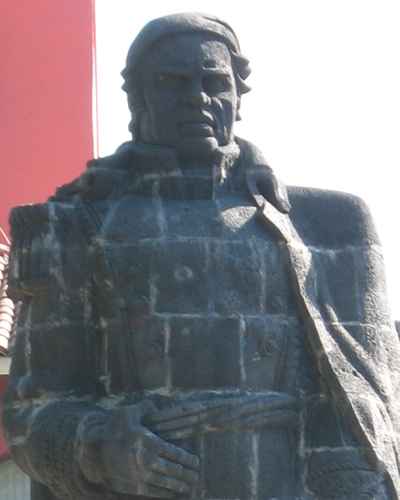
If you live outside of Mexico, you may not heave heard the name José María Morelos. But he’s a famous guy down here. We see him often, as a matter of fact – well, images of him. Our state is named after him (Morelos). There’s a huge statue of him in downtown Cuernavaca. His face can be seen on the 50 peso bill. He’s got a city named after him (the city where he was born, now called Morelia). He’s in paintings, on monuments – this is one important guy in Mexican history.
Morelos was a priest. He became a leader in Mexico’s struggle for independence from Spain, which makes him a national hero today. You can read more about him in this article by Wilbert H. Timmons
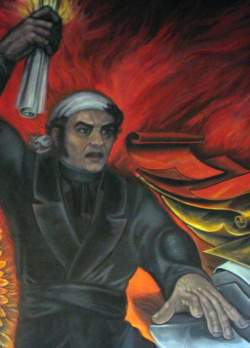
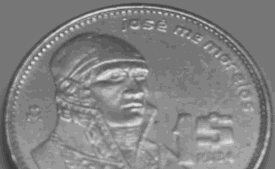
Morelos is usually pictured wearing a bandana wrapped around his head. But many people don’t know why. He’s wearing it because he has a migraine.
That’s right. Mexico’s hero suffered from terrible migraine attacks. He wrapped a cloth tightly around his head to try to dull the pain (not an unheard of treatment, by the way).
Morelos is a very unique migraineur because you can still see him wearing the badge of the pain he had to go through. Here you can see a painting of him from the Palacio de Justicia (Palace of Justice) in Morelia (photo courtesy of eperales). Below is a 1 peso coin (no longer in circulation) (photo courtesy of TFDuesing). Finally, I’ve posted a photo of the statue that’s downtown here in Cuernavaca (photo courtesy of apparentbliss).
So there you go, a fellow migraineur who’s a lot more famous than me. And now you know the rest of the story.
Apparently, once a year there’s quite a large celebration in Cuernavaca (in August/September) in honour of the image of the Virgen. The street (which is a major street) is closed off and there’s a party for more than a week.
I asked my teacher why people come to the party. The answer was, a lot of reasons. People looking for a miracle. But many just coming for the party, coming with friends, coming for the food.
Today, the church was almost empty. I’ve mentioned before that few Mexicans actually attend mass; today I read that few who are baptized Catholics attend. The Roman Catholic Church in Mexico itself estimates that only 6-9% attend mass. It’s been said that often expatriates and nuns or priests outnumber Mexican Roman Catholics. If every baptized Roman Catholic were to attend mass, there would be nowhere near the churches needed to hold them all. (This from the newspaper Reforma, 24-Feb-2007)
Not only do few Mexicans understand the transforming truth of the Bible, few really have a thought-through faith of any kind. The religious parties in the culture are not demonstrating a faith in the Lord.