Why Saturday Nights R Cool.
Saturday nights. They’re great.
Some tacos of various kinds…
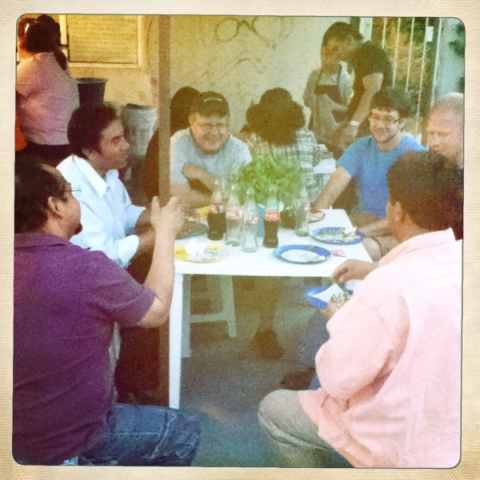
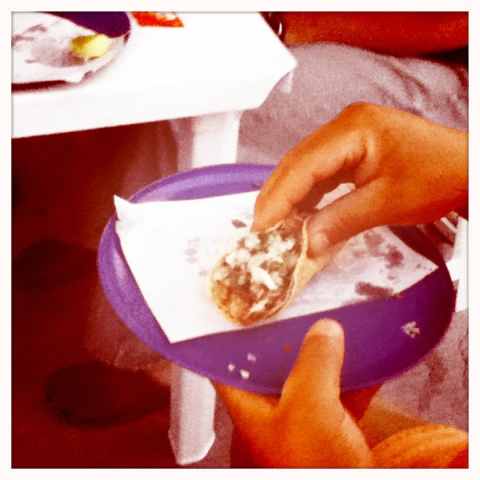
(tongue taco)
Talking about the Bible (tonight it was 1 Thessalonians)…
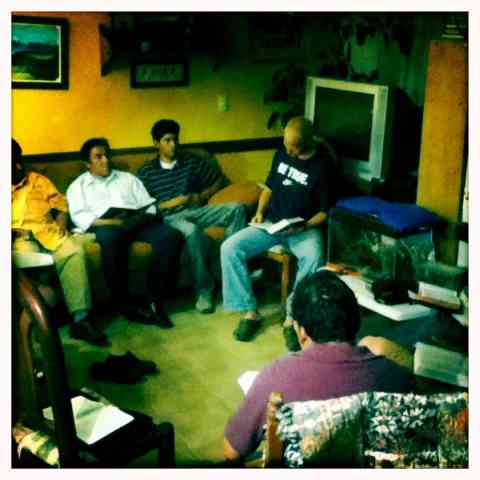
…good times with friends!

Saturday nights. They’re great.
Some tacos of various kinds…
(tongue taco)
Talking about the Bible (tonight it was 1 Thessalonians)…
…good times with friends!
For our Bible study, Where did the Bible come from?, we talked about many different Bible versions in Spanish (the good, the bad, and the ugly!). I wanted to give people access to some of the versions out there, so I’ve created this list of some of the versions that are currently available online.
Note: some versions I intentionally left off the list for various reasons, others are not currently available free online to my knowledge. Also, there are a number of versions available at BibleGateway.com, but I in my links below I try to start with an interface in Spanish as much as possible.
Here’s the list, with the name of the version, the date (of the linked version, not necessarily the first edition), and a handy URL to use to find it…
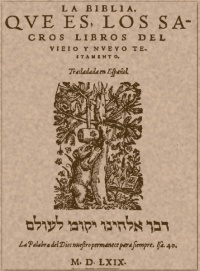 |
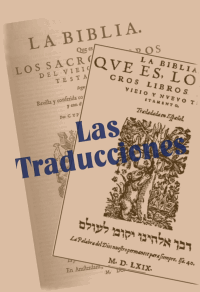
La Biblia del Oso (The Bear Bible) was the first full Bible to be printed in Spanish. La Biblia Mexicana de Vence (The Vence Mexican Bible) was the first Mexican translation. It was in 25 volumes (!) – a parallel Bible in Spanish and Latin, but I’ve included just 4 volumes as samples.
La Biblia del Oso (1569) — https://bit.ly/2JXgYQF
La Biblia Mexicana de Vence (1831) 1 — http://tinyurl.com/vence1831-1
La Biblia Mexicana de Vence (1831) 4 — http://tinyurl.com/vence1831-4
La Biblia Mexicana de Vence (1831) 5 — http://tinyurl.com/vence1831-5
La Biblia Mexicana de Vence (1831) 7 — http://tinyurl.com/vence1831-7
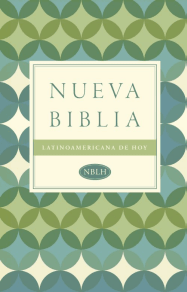
As far as I know these are all still in print today. The most common Bible in Spanish is probably the Reina-Valera 1960 (a descendant of La Biblia del Oso), likely followed by a Roman Catholic version, La Biblia de Jerusalén (based on a French translation). The four in bold are ones I focused more on in the study, because they give a good spectrum of different types of translation.
 |
Reina-Valera Antigua (1865) — https://bit.ly/rv-1865
Reina-Valera (1909) — http://tinyurl.com/rv1909
Reina-Valera (1960) — https://bit.ly/rv-1960
Reina-Valera (1995) — http://tinyurl.com/rv1995
Dios Habla Hoy (1996) — https://bit.ly/dhh-biblia
La Biblia de las Americas (1997) — http://tinyurl.com/lbla1997
Nueva Versión Internacional (1999) — https://bit.ly/nvi-1999
Nueva Biblia de las Américas (2005) — http://tinyurl.com/nblh2005
Reina-Valera (1960) — https://bit.ly/rv1960-audio
Nueva Versión Internacional — https://bit.ly/nvi-audio
The New Testament in La Biblia las Américas or Nueva Versión Internacional — http://tinyurl.com/lbla-nvi
To read this information in Spanish, visit Versiones de la Biblia en Español – Gratis en Internet
Last night was the second last part of the 7 week study – Where did the Bible Come From? The topic: translations. As you may guess, this was a bit of an adventurous topic for me to teach – that’s right, me with my poor Spanish teaching a bunch of Mexicans about Spanish translations! 😉
 |
But of course it was really more about giving them the tools to find good versions to use, and not about me giving them all the answers.
As you’ll see in the video below, I set up a bit of a Bible translation museum, with 17 different Spanish translations throughout history, starting in 1432 AD. Most of them had the name, a date, the front page or cover, and a sample text. I ended up using the first part of Psalm 18 as the sample for most of them (there were a couple where I couldn’t find that specific text in time for the study). Of course, there were many many versions I left out!
So, of course there were some of the earliest translations, the first printed Spanish Bible, (actually, Old Testament only in that case, as I recall), the first Mexican translation (the Vence Bible, in 25 volumes!), the first official Roman Catholic Version, and many popular versions of today.
So everyone got to wander around and read and compare various versions. Then we talked about differences between versions, manuscripts, the Textus Receptus, thoughts about the pros and cons of various versions, things like that.
I was able to come up with a nifty list of Spanish translations available free online. I’m actually going to hand it out next week, because I didn’t have a chance to print it for this week. But I’ll try to post it here for those who are interested.
Next week is the last week of the study! I hope we can pull everything together in a very practical way – talk a bit about what exactly we mean when we say that the Bible is the Word of God, have some fun, and, one way or another, make food a part of the evening. 😉
This past Tuesday was the fourth week of the new study (there will be seven weeks altogether). In a dramatic change of pace, we found ourselves discussing the story of Javier the louse.
It’s taken me quite a while to wrap my mind around how the Bible has been transmitted to us through centuries of copying. Sometimes this is presented to us as a bad thing, as if something was being copied and recopied to the extent that we no longer have any idea what the original really was.
In reality, that’s not the case at all. In fact, I made the case that this was a brilliant way for God to preserve His Word. Far better than it would have been if He had given us the New Testament in the age of photocopiers, cameras, and the internet. And far better than it would have been if we had a series of copies where no errors had ever been made.
Instead of trying to explain it, I tried to show it.
 |
It went all right – I think the idea needs some refining, but it worked. For some odd reason I completely left out the last 10 minutes of my talk, though – I guess I’ll tack some of it on next week!
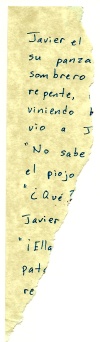
What I did essentially was actually create an imaginary manuscript history. I wrote a page of a story about Javier the louse, then gave it a complex history of being copied (similar to the New Testament manuscript history), which included 3 locations, various different "errors", and even intentional alterations to the story. 600 years of manuscripts were created, some complete, some fragments, a whole bunch almost completely missing from one area (due to severe louse persecution, I suppose). So three groups ended up with … I forget, maybe 50 manuscripts and fragments.
Then they had to see if they could figure out what the original said.
If it didn’t help anyone else, it did help me to see just how hard it was to actually corrupt the text when it was being transmitted and copied the way the New Testament text was. And here I was making many more constant, intentional errors than would have been made in real life.
Of course I won’t take the time to explain it all here – but hey, maybe sometime if I’m in the area I can try it at your church. It’s an interesting way to see exactly how God providentially spread His Word over a couple of millenia.
Over the next three weeks, I hope to pull things together so that people can really remember and use what they’ve learned. But there’s a lot to be done still. Next week’s topic is the canon. You know, that index of Bible books that there’s been so much discussion about.
Incidentally, except for one group that just ran out of time, no one had trouble getting to the original text about Javier the Louse in a very short period of time. So we really can know the real Javier. 😉
Tonight is the grand finale of the Chronological Bible Study – week 15. It’s been a great 15 weeks! And now we have a set of material that we can use again.
This week’s theme is The Triumph of the Lamb, based around Revelation 5. Also, we’re going to do a whirlwind tour of the last 15 weeks, and take a look at the themes (or – theme!) that run throughout Scripture.
We would appreciate your prayers as we close this study. Pray that each person would continue to learn about the Gospel and God’s Word.
Jesus said…
Here’s a brief video I came across recently that touches on many of the topics we talked about in our study…