Retro: Peace Like A River
For a while we had the privilege of serving at a local senior’s shelter. Here’s a quick video with some people you may recognize, leading music, ten years ago today…

For a while we had the privilege of serving at a local senior’s shelter. Here’s a quick video with some people you may recognize, leading music, ten years ago today…
Yesterday, after much Sunday morning anticipation, we reached Hebrews 7 and the discussion of the King-Priest Melchizedek. Fascinating chapter.
Some writers seem to suggest that the author of Hebrews grabbed an obscure verse from the Bible (Psalm 110:4) in order to teach a somewhat novel theology. And, in some ways, the verse is obscure – Melchizedek is mentioned only twice in the Old Testament – in Genesis 14 (the historical description), and then a thousand years later in Psalm 110.
Another 1000 years later, the author of Hebrews blows the dust of the story and gives it another go.
Hebrews has been making a big deal of the oaths that God made, so I did a quick study of God’s oaths in the OT – places where God specifically swears about the truth of something, or He swears that He will keep a promise.
In short, here’s what I discovered – but you might like to do a more in-depth study. There are two main streams of oaths that God makes.
First, an Oath of Judgement. He swears to punish Israel when she is unfaithful. He also swears to punish the nations who are against Israel – actually a fulfillment of God’s promise to Abram – “I will bless those who bless you, and him who dishonours you I will curse, and in you all the families of the earth shall be blessed” (Genesis 12:3). Those are the two main types of judgement oaths.
Second, an Oath of Blessing. First, and probably most commonly mentioned in the Bible, His oath to Abraham. To make Abraham a great nation, and to give his descendants the Promised Land. Take for example the classic from Genesis 22:
By myself I have sworn, declares the Lord … I will surely bless you, and I will surely multiply your offspring as the stars of heaven and as the sand that is on the seashore. And your offspring shall possess the gate of his enemies…
From Genesis 22:15-18
Of course, the greatest blessing comes not from Abraham’s descendants, but from his Descendant, Jesus (Galatians 3:16).
The second main oath of blessing is for David. The classic passage is actually 2 Samuel 7, but the actual reference to God swearing an oath comes up in other passages – such as Psalm 89:
Once for all I have sworn by my holiness;
Psalm 89:35-36
I will not lie to David.
His offspring shall endure forever,
his throne as long as the sun before me.
Psalm 110 falls directly into this second important stream. It’s a promise to the royal Descendant of David Himself, King Jesus.
The LORD says to my Lord:
Psalm 110:1
“Sit at my right hand,
until I make your enemies your footstool.â€
So all of a sudden this verse about Melchizedek isn’t as obscure as I thought, but part of the second great stream of oaths of blessing. But, of course, it still appears out of nowhere in some ways. The most surprising thing is that the Messiah-King would not just be a king like David, He would also be a king-priest, like Melchizedek:
The LORD has sworn
Psalm 110:4
and will not change his mind,
“You are a priest forever
after the order of Melchizedek.â€
There are hints of this in other places in the Old Testament, but this verse really does explain how it would be possible for a king to be a priest, something forbidden under the Mosaic Law. Jesus’ role would come from an earlier tradition, something outside of, and greater than, the laws about Levites and descendants of Aaron.
And so, prophetically, David pulls together various hints in the Scriptures in Psalm 110 (read more about this Psalm in Promises of a Messiah).
One other interesting note – at least three of the main types of oaths are directly mentioned in the Psalms, a book that the author of Hebrews quotes from frequently, including a lengthy discussion of God’s judgement on the unbelieving Israelites (Psalm 95:7-11). Psalm 110 also mentions judgement of the nations (Psalm 110:6). And of course the promises to Abraham and David are very important in various Psalms.
The author of Hebrews – ultimately the Holy Spirit – knew what he was doing when he pointed us to the oaths of God – kind, precious confirmations that He would do as He promised – bring us salvation and finally bring peace to the earth under His Son.
Sometimes you just need to step back and be thankful.
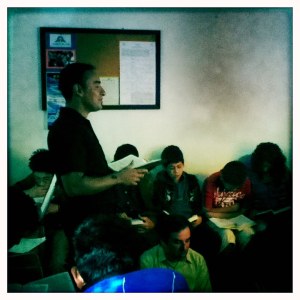 David teaching from the Gospel of Mark 23 January 2011 |
Well, of course, we’ve been thankful for the number of people we’ve been seeing worship with us, people at the Bible studies, and our prayer times. Sure, sometimes we wonder where we’re going to put everyone. But still, we’re excited.
We’re excited to see many new people, many coming to community centre classes and events. And we’re so thankful to see people making confessions of faith in the Lord Jesus (Rom 10:8-9).
Of course we know that people come with mixed motives – we all do, truth be told. And sometimes we wonder what those motives are, and we wonder who will still be here when times are hard.
We think about strategies and events and programs. But all these things sometimes obscure one simple fact.
People are coming to hear God’s Word.
And they’re not just coming and sitting. They’re struggling to find things in their Bibles. They’re asking questions. They’re trying to understand God’s will for their lives.
Frankly, this is extremely unnatural. We don’t want to hear God’s Word. We prefer darkness to light (John 3:19-20). Our hearts are naturally bent against the Lord.
So when we see, like this morning, people crowding in a tiny room to find a seat. People sitting outside and straining to hear. Children crammed in a tiny room with few resources. We know that this is God’s doing.
It really is amazing to see. Frankly, in some places here in Mexico, people risk their lives to come to a worship service. They are threatened, and their families are threatened. We can be thankful that, for the time being, we have peace here.
Some people are abandoned by their families for their faith, or they are emotionally abused because of their decision to follow the Lord.
It’s not easy to be a disciple. It’s not easy to really hear the Word of the Lord.
So thank God with us that He is working here! That His Word is spreading! Pray that the seed of God’s Word would land in good soil, and that roots would be deep.
While you’re here, I would appreciate it if you could continue to pray for Shari. She’s been sick for over a month. We’ve been to the doctor three times, and for a time she’s felt a little better, then worse again.
For the past few days she’s been in bed. She’s resting now, which I’m thankful for. But if there’s not improvement soon, we’ll have to decide what to do next.
Thanks so much for your prayers – and thanksgiving! Have a great day!
This week we’re going back to King David for another remarkable Psalm. David, apparently feeling forsaken and surrounded by enemies, wrote a magnificent piece of poetry in Psalm 22.
But there are some strange things about the Psalm. We don’t know of anything in this life of David that specifically and literally fits what he describes. It may be he’s speaking poetically, or maybe this is just an episode that wasn’t recorded in Scripture.
However, we do know the Psalm was prophetic – and we can see how it describes, with remarkable detail, the crucifixion of the Messiah a thousand years later.
Another interesting thing about Psalm 22 – there is no condemning of enemies and no demand of judgement. And no confession of sin. This is a righteous man being put to death by the wicked, and yet he doesn’t rail against his enemies.
My God, my God, why have you forsaken me? Why are you so far from saving me, from the words of my groaning?
(Psa 22:1-2)
And at the ninth hour Jesus cried with a loud voice, "Eloi, Eloi, lema sabachthani?" which means, "My God, my God, why have you forsaken me?"
(Mar 15:34)
But I am a worm and not a man, scorned by mankind and despised by the people. All who see me mock me; they make mouths at me; they wag their heads; "He trusts in the LORD; let him deliver him; let him rescue him, for he delights in him!"
(Psa 22:6-8)
And those who passed by derided him, wagging their heads … So also the chief priests, with the scribes and elders, mocked him, saying, "He saved others; he cannot save himself. He is the King of Israel; let him come down now from the cross, and we will believe in him. He trusts in God; let God deliver him now, if he desires him. For he said, ‘I am the Son of God.’"
(Mat 27:39-43)
Yet you are he who took me from the womb; you made me trust you at my mother’s breasts. On you was I cast from my birth, and from my mother’s womb you have been my God.
(Psa 22:9-10)
And Mary said to the angel, "How will this be, since I am a virgin?"
And the angel answered her, "The Holy Spirit will come upon you, and the power of the Most High will overshadow you; therefore the child to be born will be called holy–the Son of God…"
(Luk 1:34-35)
 |
For dogs encompass me; a company of evildoers encircles me; they have pierced my hands and feet –I can count all my bones– they stare and gloat over me;
(Psa 22:16-17)
And when they came to the place that is called The Skull, there they crucified him, and the criminals, one on his right and one on his left.
(Luk 23:33)
they divide my garments among them, and for my clothing they cast lots.
(Psa 22:18)
And when they had crucified him, they divided his garments among them by casting lots.
(Mat 27:35)
There has been some discussion about the translation of the word "pierced" in verse 16. Using the imagery of the Psalm, it seems to refer to a tearing at the hands and feet by the animals (the wicked people attacking).
The translators of the Septuagint, many years before Christ, thought that "pierced" was accurate enough to use it in the Greek. Others translated it pierced or disfigured, such as the Jewish Yalkut Shimoni, and Aquila, a convert from Christianity to Judaism around 133AD.
And of course other passages refer to the Messiah being pierced, such as Isaiah 53:5 (the word wounded carried the idea of pierced through) and Zechariah 12:10.
The piercing or wounding of hands and feet is a remarkable thing to write, in a society where crucifixion was unknown – and wouldn’t be known for many hundreds of years. Taken together with the rest of the description, it’s clearly describing the scene that would take place outside Jerusalem in the time of the Messiah.
The author of the book of Hebrews quotes from Psalm 22 – the song of praise that the Messiah sings after saving His people:
But we see him who for a little while was made lower than the angels, namely Jesus, crowned with glory and honor because of the suffering of death, so that by the grace of God he might taste death for everyone.
For it was fitting that he, for whom and by whom all things exist, in bringing many sons to glory, should make the founder of their salvation perfect through suffering.
For he who sanctifies and those who are sanctified all have one source. That is why he is not ashamed to call them brothers, saying, "I will tell of your name to my brothers; in the midst of the congregation I will sing your praise."
(Heb 2:9-12 – see Psalm 22:22)
The righteous Man was slain by the wicked – but it was a part of a greater purpose of God – to bring salvation. His people were crucified with Him, and will rise in His power, to the glory of God.
As the Apostle Paul said:
I have been crucified with Christ. It is no longer I who live, but Christ who lives in me. And the life I now live in the flesh I live by faith in the Son of God, who loved me and gave himself for me.
(Gal 2:20)