
Christmas Song #8: Index and Resources – and a Bonus Surprise!
Thanks for joining us for our brief tour of the great Christmas carol, “What Child is This?”! Here’s an index of this year’s posts, as well as some additional resources to check out. And check out below for one more interesting note about a change that has been made in modern renditions of the song, and what the original is actually referring to.
- Introduction
- Christmas Song #8: Contrasts
- Christmas Song #8: He Lived Among Us
- Christmas Song #8: A Change of Attitude
Resources
- What Child is This? (lyrics – The Cyber Hymnal)
- What Child is This? (lyrics, biography of the author – Hymnary.org)
- References to Greensleeves in Shakespeare
- What Child is This? (devotional – Robert Cottrill at Wordwise)
- Today in 1837 – William Dix Born (Wordwise – more on the author)
- Today in 1898 – William Dix Died (Wordwise – more on the author, specifically his Christmas songs)
- William Chatterton Dix (more details on the author)
Bonus – The Animals!
I mentioned briefly the fact that some renditions of this song leave out the last two lines in verses 2-3. But another very common change is in verse two – changing the line “Where ox and ass are feeding” to “Where ox and lamb are feeding”.
Now, we all know why this change was made – modern audiences are uncomfortable with the word “ass”, and “donkey” just isn’t going to fit with the music. But.
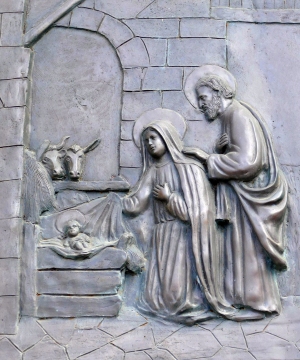
But you should probably know that there is a long, rich tradition that’s lost if you change the donkey to a lamb. Even look at the nativity scene picture I posted here. Yes, they threw in a lamb for the shepherds of Luke 2, but there they are, close together, in a modern day nativity scene – the donkey and the ox. Why?
Well, it was as early as the second or third century, or perhaps earlier, that people were making the connection. Through Isaiah, God lamented the unbelief of Israel:
An ox knows its owner,
Isaiah 1:3
And a donkey its master’s manger,
But Israel does not know;
My people do not perceive.
Yes, even the ox and donkey know their owners – actually, their owner. Not only that, they recognize his manger!
Although the gospel writers mention no animals by Jesus’ manger (we can certainly imagine that they came for their dinner and were surprised at what they found!), it would certainly be appropriate if even the animals were there to worship their Owner, especially in light of this verse.
But there’s more. As believers reflected on this, they were reminded that all creation is under its Creator, and sometimes the creation seems to be more inclined to worship God than humans are (see Psalm 19:1; Luke 19:40; Romans 1:20).
Other carols mention this pair:
- “Ox and ass before Him bow; and He is in the manger now.” (Good Christian Men, Rejoice)
- “Ox and ass kept time” (Carol of the Drum (The Little Drummer Boy) – as originally written – hear the Trapp Family Singers sing it here)
- “The ox and donkey, so they say, did keep His holy presence warm” (Burgundian Carol)
There’s even more to the tradition – another reason why these specific animals are important. Noting that the ox, under Jewish law, was a clean animal, and the donkey unclean, the two became associated with Jews and Gentiles. Hence, Jesus came for both Jews and Gentiles – for the whole world.
Of course, without all the speculation, the Bible itself tells us that – even in the Christmas story, where it’s likely (although a few have suggested otherwise) that the Magi were Gentiles, and shepherds of course Jews. Going on in the book of Matthew, even Jesus points out that many Gentiles would be in the kingdom (Matthew 8:11).
I certainly understand why the substitute is commonly made – but maybe before we quickly change traditions, we should at least think about where they came from and why they’re there, just as we should be hesitant to “move the ancient boundary” (Proverbs 22:28). No, we don’t raise tradition to the level of Scripture. But sometimes these traditions remind us of important truths.
So the next time you see the ox and donkey at a manger scene, remember – He is indeed the Owner of all creation. And He came to save not only His nation, but peoples from every nation!