
Christmas Song #8: He Lived Among Us
He is Christ, the King! exclaims the first verse of What Child Is This?. It is a surprise to find that a small baby on the lap of His mother is the Messiah, promised since the dawn of time to bring salvation.
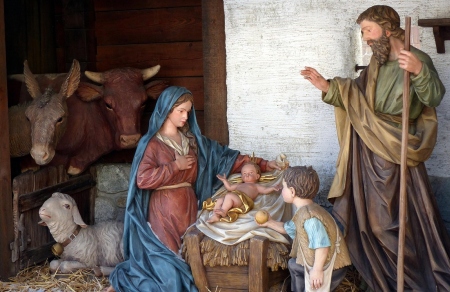
But the second verse pauses again to really look around. He’s not just a baby with His mother. He’s not in a palace, or even a nursery.
Why lies He in such mean estate,
Where ox and ass are feeding?
“Mean” – as in “poor, dirty, and of bad quality” (Cambridge Dictionary). A “mean estate” refers to poor circumstances – a feeding place for farm animals. Of all places, why is He here?
William Dix, the author of this carol, was familiar with suffering himself. His father apparently drank heavily, and eventually abandoned the family. At one point, some of his writings were exposed as fraudulent. The family had many reasons to be embarrassed and ashamed, not to mention in danger of being in a very “mean estate” themselves.
William himself had a varied career. As a young man he apprenticed with his grandfather (his mother’s father) as a soap and candle maker. When he grew up, he worked at and eventually managed a marine insurance company. He must have been familiar with more suffering in a job like that.
At one point, early in his life, he became very sick – near death. This became a major time of spiritual growth. In fact, he later confided “It is a somewhat curious fact that most of my best known hymns were written when I was suffering from some bodily ailment.”
One of the first of these was “Come Unto Me, Ye Weary”:
“Come unto Me, ye weary, and I will give you rest.”
O blessèd voice of Jesus, which comes to hearts oppressed!
It tells of benediction, of pardon, grace and peace,
Of joy that hath no ending, of love which cannot cease.
But here is the Saviour Himself in lowly circumstances. He truly “became flesh, and dwelt among us” (John 1:14). But the verse continues:
Good Christians, fear, for sinners here
The silent Word is pleading.
The point is perhaps not that Jesus was praying in His manger-cradle, but that His whole life was one of bringing salvation to sinners. To quote all of John 1:14,
And the Word became flesh, and dwelt among us, and we beheld His glory, glory as of the only begotten from the Father, full of grace and truth.
This was the earthly beginning of the great work of Christ, the King.
Nails, spear shall pierce Him through,
The cross be borne for me, for you.
Hail, hail the Word made flesh,
The Babe, the son of Mary.
As Isaiah prophesied centuries before Jesus was born:
But He was pierced through for our transgressions,
Isaiah 53:5
He was crushed for our iniquities;
The chastening for our peace fell upon Him,
And by His wounds we are healed.
What is our response? To “fear” – this is no ordinary child that can be overlooked. This is not even just another king. This is the King who came to give Himself for us.
And so we look into the past at the Baby in a manger, perhaps first in curiosity or confusion, but then when we know more – in fear and awe and reference and thankfulness.
It is a shame that for some reason some versions of this song cut out the last lines of the second and third verse, simply repeating the last two lines of verse 1 (“Haste, haste, to bring Him laud, the Babe, the son of Mary”). This takes away from the responses that Dix intended. First, we hurry to praise Him. Now we acknowledge Him both for who He is and His purpose in coming.
He came to sacrifice Himself to bring us salvation from sin and death. “…the Son of Man has come to seek and to save the lost” (Luke 19:10).