
Missions
The Challenge of Mexico City
On Friday night I went to Texcoco (east of Mexico City, toward the north) to meet with some of the CAM International missionaries from the Mexico City area. We were there to see the mission director and his wife (Dan and Sue Wicher, who were served for years in Mexico City themselves), and two of the CAM board members; Jon Campbell (his wife is Wanda but she wasn’t there) and Walter and Dottie Baker.
One thing that was interesting was that everyone was sharing about the joys and challenges of working in Mexico City.
Many of the joys we talked about are what you might expect anywhere – watching Jesus "invade a family", for example (as Rod Fry said during his presentation). But I thought you might be interested to hear about some of the challenges we talked about.
 |
- Traffic. Just getting from one place to another. People may look at Mexico City and wonder why it’s so hard for us to get together with believers from other areas. But when people are an hour or two late for meetings like this one (even people with board members in their car), they are reminded. It’s not easy to get around in Mexico City. You plan for it, but it’s drastically unpredictable. When Mayra Fry came to pick me up Friday, she was stopped by the police. When Rod and I left from his house and headed to Texcoco, we were stopped by the police (not because any of us did anything wrong, by the way. No one got a ticket.). And we were among the first to arrive. There are accidents, construction, delays of all kinds.
- Fear. One missionary mentioned just the challenge of safety in the big city. Every missionary does need to take precautions and be aware.
- Discipleship. I was trying to carry on with my one-word summaries – maybe that’s not the best word. But one missionary shared what they’d heard from a Mexican believer. The Mexican pointed out that so many of the Mexican believers are first generation Christians. That means there is an incredible lack of role models. They’ve never seen a functioning Christian marriage, or how to parent as a believer, or what Christ-like leadership looks like. It’s exciting when your church is almost all new disciples – but it calls for a different kind of discipleship.
- Commitment. Someone else pointed out (and I’ve heard this a lot) the challenge of a lack of commitment. Now, a disclaimer here – there are many very committed people here – Mexican and non-Mexican. But when you’re on the front lines of disciple-making this is always a challenge, no matter where you are.
This reminds me of the great summary of challenges that Dennis Poulette shared in his post If you can minister in Mexico City… He listed space, transportation and time. That was in the context of youth ministry, but I think those three things fit everywhere.
If you work in Mexico City, I would love to hear what you would add to the list.
I can’t be a missionary, I’m not a people person! (guest blogger)
I got special permission from Beth McManus (who serves with CAM International with her family in San Juan del RÃo, Querétero, México) to post this email she sent. You can visit the website of the McManus family here.
I used to think that missionaries should be people persons. They should be energized by being with others. They should love being in crowds, talking, laughing, attracting others through their charisma. You’d think that having grown up on the field as an MK, I’d know better.
God doesn’t just call one type of person. The missionary body is every bit as diverse as the church body, each being asked to be the part God designed them to be. Christ doesn’t just use mouths to share the gospel, He uses hands and feet and knees and shoulders and eyes and even pinky toes! As I watch our mission body work, I am amazed at how different we all are. Some are accountant types, needing everything written out, planning to the last penny and accounting for every minute. Others are such people persons that they can’t plan a day to save their lives, “Appointment? I had an appointment with you? Oh well, I met this friend on the street and he needed to talk and so I took him for coffee and . . . ” Some are glum and pessimistic about life. Some are so visionary that they overwhelm everybody else. Some are in the middle, plodders who just “get the job done.” Some love get-togethers and socializing. Some would rather hide in a cave forever. Some vacillate between the two.
Some are short. Some are tall. Fat or thin, God uses all! (I’ve been inputting lots of books this week and am in the middle of Dr. Seuss. Can you tell?)
I think I’m in the middle. I’m not a people person, but I’m not a hermit either. I often dread activities with church people, the youth, or missionaries and then when I get there, I enjoy them. I like to listen to people and pray for them and try to help them, but every now and then I hit the wall.
I hit the wall after helping with 6 teams and having other guests all summer. I got to the point that I had a mini-panic attack about going to church one Sunday and would have skipped if my dear husband hadn’t ordered me to get ready and come with. I dreaded our team’s prayer meeting a couple weeks running. AND I even avoided my children, Alan and Mom as much as possible this week.
Alan has been working for weeks on a getaway for us but, being rainy season, it just didn’t seem worth it to pay to go somewhere only to be rained out. I found myself longing to just borrow somebody’s house, to just go somewhere that we don’t have to be company or answer phones or doors or talk about work or think about work or think about anything! The funny thing is that I never thought to PRAY about it. I just wished and longed.
Alan settled on a place and called some dear missionary friends who are like an Uncle and Aunt to me, asking if we could stay with them a night or two on the way to and from our destination. Lo and behold! They are on their way to Guatemala for a couple weeks and invited us to stay in their house the whole time! I got my wish!
God heard the longing in my heart and, in His great love, gave it to me even though I never thought to ask. It’s not that I didn’t think He cared or that I thought He’s too busy for “such little things” as vacation. I think I got overwhelmed with the cares of this world and forgot to keep looking to Him. I’ve often looked down on Peter for sinking in the waves instead of finishing his walk over the water to Jesus. I’ve often thought, “If I’d been there, I wouldn’t have done something so dumb!” Hmmm! Pride goeth before a fall, huh! Yet God uses me! He relishes my weakness because it shows His power when He works in and through me! I’m just amazed!
Teaching children respect and conviction…
To explain all the ins and outs of what happened around here yesterday would simply take too long. But let’s just say that some events really brought a lot of important issues together – family, ministry, eternity, culture.
Now let me say this up front – we don’t have children who walk around with halos, who look to heaven frequently and say profound spiritual missionaryish things in Old English. Of course we try to teach our kids intentionally and carefully (of course we often do less than we should), but sometimes we wonder how much is sinking in.
So how do you teach your children to have convictions about the truth, and yet to respect others who don’t share those convictions? Especially when the children are so young, and really can’t understand so many of the implications of what goes on around them?
I remember being around Hannah’s age (she’s 7), when I was really starting to sort out and interpret the world around me. At that age I really wanted to understand things on my own, and had to be gently corrected when I got the wrong idea from what I saw. Of course, that’s a process that goes on the rest of your life!
We’re proud of Nathanael and Hannah. We’ve seen them at various times show that they care about people, that they’re developing their own convictions, and that they really do want to share what they learn with their friends. They’re also beginning to understand how important they are in God’s eyes, and more key – how important God is.
So now, how do we teach them how to interact with the ideas of others? To learn from others, and yet be bold to share their own ideas? To share with "meekness" and not out of pride (1 Peter 3:15)? To observe the behaviour of others without imitating it when it’s inappropriate?
And how do we teach them when these are all things we’re still struggling with ourselves?
Yes, we’re fellow travellers with our children. And sometimes the children lead (Matthew 21:12-16)…
The Prusias in Ixtapaluca (video)
The Prusias are preparing for the big (and really cool) move to Mexico! Their passion is to be involved in camping and youth ministries using martial arts (for more, be sure to visit the Prusia’s website).
Recently they kicked and chopped (to be hopelessly cliché) their way down to Mexico for a visit. And, of course, they stopped by Ixtapaluca (who wouldn’t?).
So I thought you would enjoy this video of their visit. Not only can you get to know the Prusias, you can also see some shots of our area. So without further ado, the Prusia Mexico Missions Trip 2008:
Johnny Appleseed – the missionary?
Johnny Appleseed is a name that you’ve probably heard a lot. I know I have. That’s why I set out to learn a little more – you know, beyond the apples.
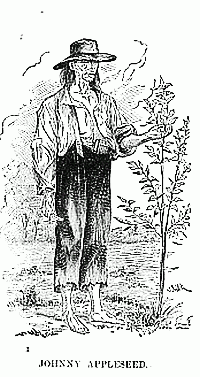 |
Johnny Appleseed’s real name was John Chapman. He was born in the USA – well, what was to become the USA, in 1774. Chapman was a pioneer, who, of course, grew apple trees. Actually, he planted nurseries far and wide, hoping that they would provide food so that people would not have to go hungry. He would travel back to care for and prune the trees, and sell the trees or tracts of land, or give them away. You might call him an itinerant land developer.
But Chapman was driven not only by environmentalism or concern for the poor. He was actually a missionary for the Church of the New Jerusalem, or Swedenborgianism.
Swedenborgianism was fairly new at this time, having come to the new world from England. The movement was based on the works of Emanuel Swedenborg of Sweden.
In spite of the biblical sounding name of "church", the organization (still alive today, though small) is a long way off from traditional Christian beliefs. Instead of teaching that we are saved by grace through Jesus, the teaching is that we are saved by belief and a life of good works (one church website writes,"God does not judge us, but we judge ourselves by what we love and how we live. People of every faith are saved if they live sincerely according to their religion.").
There is no Trinity, except for a trinity of being that exists in Jesus alone. Jesus is not going to return suddenly – actually, he has come, or is in the process of coming. There is no Satan as the Bible teaches – all evil comes from humanity. Several books of the Bible are rejected – sometimes Swedenborg’s works are considered to be Scripture themselves. Either way, the followers of Swedenborg believe that the Bible can be "properly" understood through his teachings.
The teachings of the movement were mystical – that is, you can’t simply understand Scripture by reading – there is a deeper, spiritual meaning that must be seen through Swedenborg’s writings. This is why "true" Christianity was lost for so many years.
Chapman was a missionary for the Church of the New Jerusalem. He carried with him materials by Swedenborg, and handed out literature whenever he could. He shared these beliefs with people as often as he could on the frontier. His opening line when coming to stay with a settler was "Would you like to hear some news right fresh from heaven?"
How successful was Johnny Appleseed in spreading these beliefs? Well, we do know that the movement grew for some time, though it was never a large organization. In the later 1800s there was a lot of controversy over how authoritative Swedenborg’s writings were. The controversy was to split the people and begin an overall decline.
In spite of Johnny Appleseed’s rejection of many biblical teachings, he did accept and live by many that led many to admire him. Chapman was concerned for the poor. He did not accumulate wealth for himself (often dressing in the worst rags), but gave what he could to those in need. His concern for the environment and desire to develop it to help others left a rich heritage. Many of the orchards he planted have survived to this day (and are worth millions). He had a deep concern for animals, even insects.
I would have to argue that his care for others (above himself) and the environment are very biblical ideas (Leviticus 19:18; Proverbs 12:10; Gen 2:15; Psalm 107:27-31). However, his rejection of the God who has shown Himself in that Creation, and in the Bible, was tragic. No matter how noble our lives may be, we cannot find true peace if we reject the peace God offers (1Thessalonians 5:17; Romans 5:1).
Man cannot live by bread alone – or apples – but by every word that comes from God’s mouth (see Matthew 4:4).