(A continuation of the Biblical Anthropology series. Click the link to start at the very beginning (a very good place to start).)
Here’s a question for you: What invention from the past 150 years has most transformed our culture?
Think about it for a minute. But I’ll give you my answer.
I think that one of them has to be the affordable, mass-produced automobile. And some people may say – what about the telephone? personal computer? television? the camera? nuclear energy? antibiotics? the internet? the microwave? Ah, I’ve got it – the tea bag!
All right, all of those were pretty important.
But remember, before the last century, human beings were moving at the speed of a horse – at the most. In fact, before telephones and telegrams, most messages could only move at horse speed.
But then, along came cars and improved roads designed for them. Things may have started slow, but in a very short time in world history, many families owned their own cars.
Cars were kind of like a semi-private home that you could take with you. Public transportation wasn’t quite as private, but it still provided you with amazing independence. It became very easy to leave your family and your community and be free from their protection. You could quickly get to a place where no one knew you, and escape again when these new people got to know you. 🙂
The world became smaller. But there was a problem – you couldn’t get mama’s cooking in this new town. Wherever you travelled, you wanted to know where you could eat. And so along came the fast-food chains – McDonald’s, Subway, Dominos. And now you would also want to shop in a familiar place – Walmart, Gap, Nike. How about something to drink? Coca-Cola, Corona.
Specialized institutions were better but farther away. Hospitals. Universities.
Modern transportation contributed to the destruction of families and communities by breaking centuries-old bonds. Modern transportation allowed us to visit families and friends who lived far away – and yet, it also encouraged us to live farther away. Modern transportation transformed the economy and allowed for massive global companies. Modern transportation made knowledge more available. Modern transportation allowed the rich access to almost anything.
And all that began in Canada with the first steam buggy in 1867. Well, really, the early 20th century, when car production exploded both in Canada and Mexico.
Technology has its benefits and consequences. And yet we rarely really evaluate the latter.
Technically, “technology” is not a thing, it’s knowledge. The Cambridge Dictionary defines it as: “(the study and knowledge of) the practical, especially industrial, use of scientific discoveries…” You could say that we use technology to make things.
In the beginning, God created the heavens and the earth.
Genesis 1:1
…and then, God began to divide and organize. He used technology. And of course God used technology – or we could also use the word wisdom, to create everything in the first place – “the heavens and the earth”.
I, wisdom, dwell with prudence, and I find knowledge and discretion.
Proverbs 8:12
Down to verse 22:
The LORD possessed me at the beginning of his work, the first of his acts of old. Ages ago I was set up, at the first, before the beginning of the earth.
Proverbs 8:22-23
A little further down in the chapter:
When he established the heavens, I [wisdom] was there; when he drew a circle on the face of the deep, when he made firm the skies above, when he established the fountains of the deep, when he assigned to the sea its limit, so that the waters might not transgress his command, when he marked out the foundations of the earth, then I was beside him, like a master workman, and I was daily his delight, rejoicing before him always, rejoicing in his inhabited world and delighting in the children of man.
Proverbs 8:27-31
Of course, the man and the woman themselves were technological marvels. As David says:
For you formed my inward parts; you knitted me together in my mother’s womb. I praise you, for I am fearfully and wonderfully made. Wonderful are your works; my soul knows it very well.
Psalm 139:13-14
And God commanded the use of technology:
…fill the earth and subdue it, and have dominion over the fish of the sea and over the birds of the heavens and over every living thing that moves on the earth.
Genesis 1:28
That’s from the Creation Mandate, and that’s what we should do. Use our knowledge to put the creation to good use.
But as we have already learned, humans are fallen creatures. And so we sometimes use technology for sinful purposes.
God’s creation itself is fallen and stained. But in Jesus Christ we see the ultimate triumph of technology. He took the form of a man. He died, but then conquered death. The resurrection is a technological triumph, a victory of knowledge, that only God could accomplish.
This will be a foundation for our future exploration. So let’s put it in just a few words as we finish for today:
God is the ultimate technician.
God commands us to use technology, and when we do, we imitate Him.
God triumphed over the limitations of human technology when He raised Jesus Christ from the dead.
That’s enough to chew on for today. But next time we’ll try to learn some things from technology in the Bible. You might be surprised at what we discover.
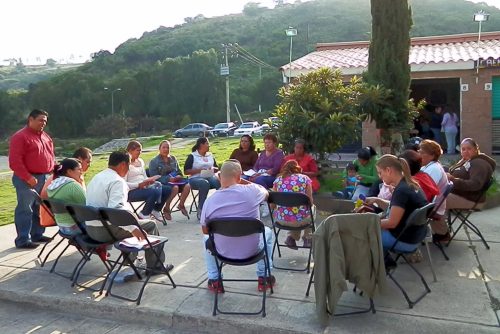
10 years ago today we were in the middle of a kids’ club in the community of Jesús María. Now, of course, many parents are delighted at the opportunity to drop off their kids and go be free for a while. However, there were some parents who stayed around – and we had a little Bible study just for them. For more, check out the post from this day in 2012.
So here they are, 10 years ago right now. Shari is in the picture if you can find her.
Here’s what happened. This topic was not originally in the Biblical Anthropology series (although it should have been). But around the same time, we were doing this series at our church in Mexico, we also found ourselves in Romans 13.
And so as I’ve been sharing this series, I’ve been including this series. I’ve already written an index for it, because I posted it last year. But I’m going to share the index again here in case you’re following along in order.
That’s just an explanation of why this doesn’t look like all the other topics. It is a little different than I would have done it as part of the Biblical Anthropology series because it is more focused on Romans 13. But it does cover other relevant passages as well. And it will be helpful as we continue the series. So here it is, part 6 – The Authorities.
I haven’t been doing this every month, but I thought I’d do it today, for fun. It sure has been a crazy time! Anyway, here are the most-read posts from the last three months in chronological order, with the most popular post of all in bold.
The Hot Water Tank – Ah yes, the adventure of the hot water tank. It’s working all right, although for some reason it’s very hard to light the pilot light.
It has been very useful to me to look at the way the Bible talks about homicide, and to think through some of the modern arguments for euthanasia and abortion and related matters. But so much of this topic is painful to even talk about. It relates to real people dealing with what may be the most difficult issues they will face in their families.
And so it was actually the last part of this study, the part that we’ll talk about today, that may have impacted my thinking the most. It’s just a brief look at what the Bible has to say about death and suffering, and how our modern world so often misses the boat completely when it comes to these topics.
Because, after all, there has been an elephant in the room in this discussion. What if someone is suffering? I mean, really suffering. Does that give anyone the right to kill that they would not otherwise have? Whether we’re talking about abortion, or euthanasia, or suicide?
Let’s start by talking about death. As Christians, we believe that to die is to go and be with Christ – we do in fact go on to a better life. (If we’re true believers, that is. God forbid that we risk passing through death when we’re not sure!)
But even though, as Paul says, “to die is gain” for a believer, that does not mean that death in itself is a “good”.
The last enemy to be destroyed is death.
1 Corinthians 15:26
What is death? The enemy.
What profit is there in my death, if I go down to the pit? Will the dust praise you? Will it tell of your faithfulness?
Psalm 30:9
We have a special purpose in this life. Even an older person who is bedridden can, in most cases, praise God and pray for their family. And that is a beautiful and powerful ministry.
Throughout the Bible, death is judgement. Death is a terrible thing. Yes, as believers we know that the Good Shepherd will guide us through the Valley of the Shadow of Death. God is always with us, even as we die. We’re not afraid of death, because we know that our Lord Jesus is waiting on the other side to receive us. But we don’t desire death itself. Personally, I would like to be here when Jesus returns, if that is His will.
Death is an enemy.
But what about suffering? There’s no doubt that suffering can be a terrible thing to go through. Some of us have experienced more suffering than others. And we don’t want to see anyone else suffering.
We know that our Lord has great compassion for those who suffer.
When he had entered Capernaum, a centurion came forward to him, appealing to him, “Lord, my servant is lying paralyzed at home, suffering terribly.” And he said to him, “I will come and heal him.”
Matthew 8:5-7
Jesus didn’t hesitate to go and help someone who was suffering. Neither should we.
But the apostles and prophets are actually examples to us of suffering, and their example may surprise us. Paul says in Colossians 1:24 – “…I rejoice in my sufferings for your sake…” In fact, we are commanded to share in suffering. “Share in suffering as a good soldier of Christ Jesus” 2 Timothy 2:3.
And we know that suffering actually has a purpose.
…we rejoice in our sufferings, knowing that suffering produces endurance, and endurance produces character, and character produces hope, and hope does not put us to shame, because God’s love has been poured into our hearts through the Holy Spirit who has been given to us.
Romans 5:3-5
Listen carefully to what Paul says here:
For this light momentary affliction is preparing for us an eternal weight of glory beyond all comparison…
2 Corinthians 4:17
Do we really understand that?
Paul is explaining that the suffering that we encounter in this life is light, compared with the reward. He’s not saying that suffering will be easy and no big deal. But in comparison … yes! Every affliction has a purpose. The world says it’s all by chance. Even some Christians claim that some suffering is beyond God’s control. But no, the Bible teaches that God has purpose even in our suffering.
We don’t seek suffering and death. But suffering is actually something that God uses in our lives. May God give us the grace to accept suffering, if it makes us more like the Lord Jesus. And remember, for a Christian, all suffering is temporary. Sickness is temporary. Old age is temporary.
How might this transform the way in which we live?
We can trust God to choose the time of our death. For ourselves, for an unborn baby, for an old man, for a disabled person, for someone with a mental illness.
And in fact, we help one another to avoid death where possible. We want everyone to have every chance to accept Christ as their Saviour. We want everyone to have the privilege to praise Him in this life, to know Him in this life. Even if all we can do is pray to Him from our sick bed. And that is a powerful service.
And what if someone has advanced dementia? Do you believe that God can still use that person? Do you believe that God may have something to teach us as we care for that person?
And is it possible that the heart of that person can still respond to God? If an unborn baby can respond to God, maybe that person can as well.
We accept suffering as a gift from God. We don’t avoid it at all cost. We recognize that it always has a purpose, and that, for believers, it is always temporary.
However. And this is very important. We should never be hasty to allow suffering in our life or the life of someone else when God has provided a way to avoid it. And obviously here I’m talking about ethical means that would be in line with God’s Word. And I’m not suggesting we accelerate the natural process of death, as we already discussed. What I am saying is that we should seek to alleviate suffering in this world when we are able to do so.
Why am I even mentioning something that seems so obvious? Because some people, even in God’s Name, have permitted or even encouraged suffering because they see that suffering has a good purpose in the Bible. Yes, suffering is good when God permits it in the life of the believer. But we see the compassion of our Lord as our example. We should do all we can to minimize suffering when God provides a way.
What do we say to the young girl who finds herself to be pregnant – who is terrified and thinks that her life is over? We don’t encourage her to murder her baby. We love them both. We serve and help them both.
When someone is sick, we don’t simply tell them that they deserve it, or that God wants them to suffer. We provide medicine. We pray for them. We bring them food.
As the body of Christ, when one member suffers, we all suffer. We bear one another’s burdens. And in the end, we look to Christ to carry our burdens.
As Christians, we don’t minimize the reality of suffering and death. But we do know that there is hope in suffering and death. We admit that we often have not valued the life of another as we should have. But we look to the Lord to give us strength to truly serve one another.
May God truly transform the way that we see the people around us, even when they are young, old, sick, or disabled. May we have an attitude of love and service toward them.